Why Do Coal-Fired Power Plant (CFPP) Chimneys Release White Smoke?
If you have ever passed by a coal-fired power plant (CFPP), you have probably seen tall chimneys releasing thick white smoke. Many people say:
• “That is coal smoke!”
• “That is dangerous pollution!”
• “That is toxic gas released into the air!”
On the other hand, some people say:
• “Don’t worry, it is just water vapor. It is safe.”
So which one is correct?
Is the white smoke dangerous or not?
The answer is not simply a matter of safe or unsafe.
In general, the white plume from a CFPP is indeed mostly water vapor — but that does not mean it is completely free from pollution. The white plume can still contain pollutants such as SO₂, NOx, PM2.5, and sulfate aerosols depending on the operating conditions of the power plant.
In this article, we will discuss it in a simple and easy-to-understand way.
1. What Is the Purpose of a CFPP Chimney?
A chimney is not just decoration, not a giant flagpole, and not only a sign that a power plant exists. A chimney has important functions:
| Function | Simple Explanation |
| Discharging combustion gases | Exhaust gases from the boiler must be released into the atmosphere |
| Reducing pollutant concentration | A taller chimney helps spread pollutants over a wider area |
| Maintaining combustion airflow | Helps maintain proper air draft |
| Keeping pollution away from people | Prevents concentrated gases from directly reaching nearby communities |
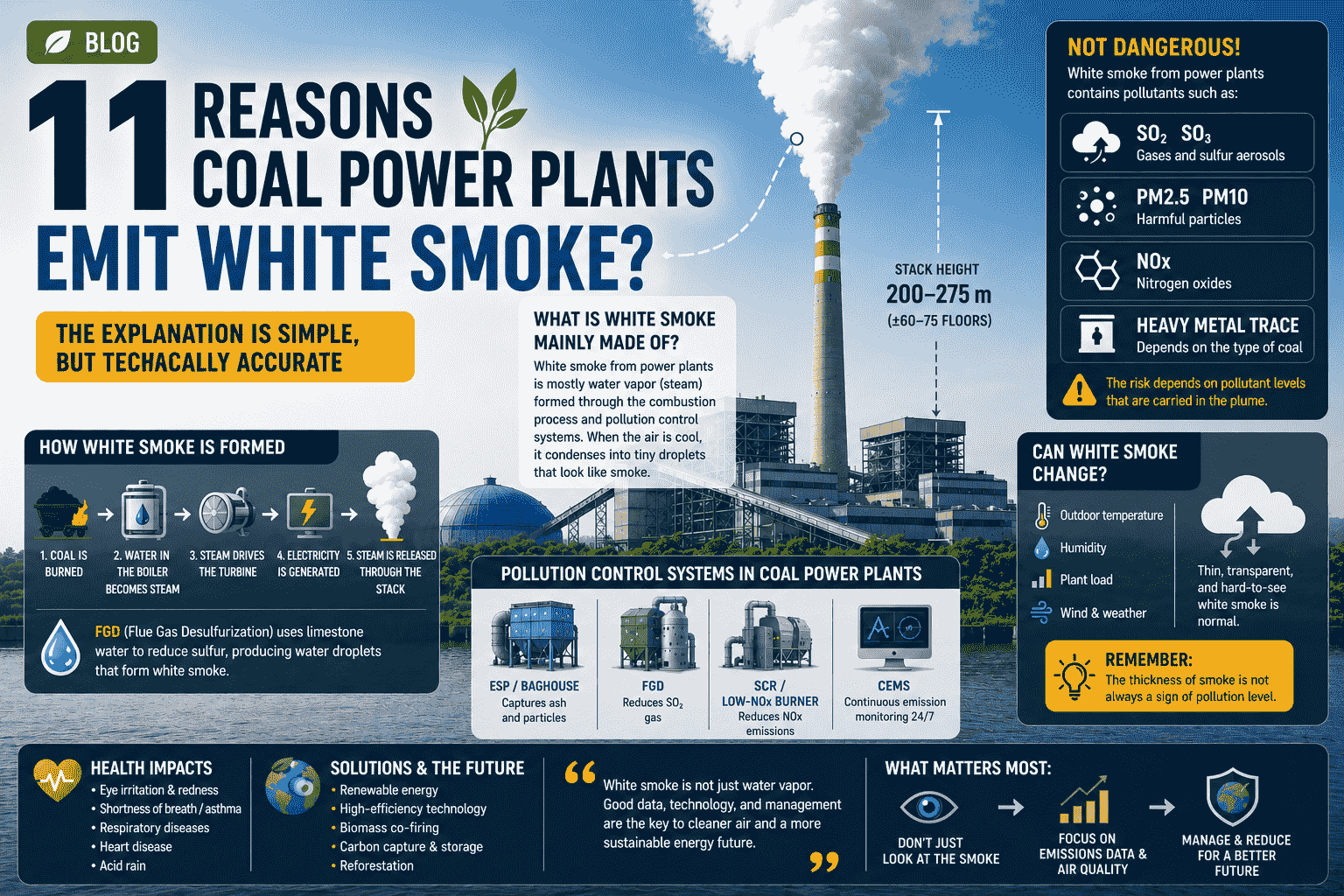
CFPP chimneys can reach around 200–275 meters, equivalent to a 60–75 story building.
2. Where Does the White Smoke Come From?
The white smoke seen from a CFPP chimney is mostly water vapor that condenses into tiny droplets.
Why does it appear white?
Because hot exhaust gas meets cooler outside air, causing water vapor to turn into small droplets, similar to morning fog.
It is similar to:
• Steam from boiling water
• Mountain fog in the morning
• Vapor from hot rice
So visually:
White plume = artificial cloud
However, white appearance does not automatically mean it is harmless.
Just like wildfire smoke — it may look light in color but can still contain dangerous PM2.5 particles.
3. Why Is There Water Vapor in a CFPP Chimney?
Because the CFPP process works like this:
Coal is burned → water in the boiler becomes steam → steam rotates the turbine → electricity is generated
After steam is used, some of it becomes water again, while some moisture can remain in the exhaust gas system.
In addition, CFPPs use pollution control systems such as FGD (Flue Gas Desulfurization).
FGD works by mixing exhaust gas with limestone slurry to reduce sulfur emissions. This process creates water droplets that can later appear as white vapor from the chimney.
4. The Important Question: Is White Smoke Dangerous?
The accurate answer:
✔ White CFPP plume is mostly water vapor, but it can still contain harmful pollutants such as:
• SO₂ and SO₃ (gases and sulfate aerosols)
• PM2.5 and PM10 (very fine particles)
• Trace heavy metals (depending on coal characteristics)
• NOx
Meaning:
🔹 It is not automatically safe
🔹 It is not automatically extremely toxic
🔹 The risk depends on the amount of pollutants carried in the plume
Why can it be harmful?
Because:
• Coal contains sulfur
• Burning coal produces SO₂
• In the atmosphere:
SO₂ + O₂ + H₂O → H₂SO₄ (sulfuric acid aerosol)
• These sulfate aerosols can become part of the white plume
In addition, PM2.5 is dangerous because the particles are extremely small and can enter the lungs and bloodstream.
5. Doesn’t a CFPP Have Pollution Control Systems?
Yes.
Modern CFPPs are equipped with pollution control technologies such as:
| System | Function |
| ESP / Baghouse | Captures ash and particulate matter |
| FGD | Reduces SO₂ emissions |
| SCR / Low-NOx Burner | Reduces NOx emissions |
| CEMS | Continuous online emission monitoring |
However, these systems reduce pollutants — they do not remove 100% of emissions.
If:
• the system does not operate properly
• coal has high sulfur content
• maintenance is poor
pollution levels can increase.
6. Why Is the White Smoke Sometimes Thick, Thin, or Invisible?
It depends on:
• Outside air temperature
• Humidity
• Power plant load
• FGD efficiency
• Wind and weather conditions
When the air is cold and humid:
→ the white plume becomes thicker.
When the air is hot and dry:
→ the plume may almost disappear.
This is why:
The thickness of the plume is not an indicator of pollution level.
A thin plume can still contain high pollutants, while a thick plume can have lower pollutant concentrations.
7. Health Impacts of CFPP Plumes
Impact Simple Explanation
Throat and eye irritation From SO₂ and acid aerosols
Breathing problems / asthma From PM2.5 exposure
Long-term heart and lung disease PM2.5 can enter the bloodstream
Acid rain From SO₂ and NOx
So even though it looks “clean and white,” small particles can still create health risks.
8. Why Do Many People Misunderstand It?
Because of visual perception.
People often think:
• White = clean
• Black = pollution
But:
• The most dangerous pollutants are often invisible.
Examples:
• PM2.5 cannot be seen
• SO₂ cannot be seen
• CO has no smell
• Cigarette smoke can look white but is harmful
9. Are All CFPPs the Same?
No.
The impact depends on many factors:
| Factor | Influence |
| Coal sulfur content | Higher sulfur means higher risk |
| Power plant technology | Ultra-supercritical plants are more efficient |
| Filtration systems | Better systems mean cleaner emissions |
| Maintenance and operation | Poor operation can increase emissions |
| Distance from communities | Closer areas have higher exposure risk |
| Government regulations | Determine emission limits |
10. Do Other Countries Still Use CFPPs?
Yes.
Countries such as:
• China
• India
• Indonesia
• Japan
• South Korea
• United States
still operate coal-fired power plants.
However, many are transitioning toward:
• Supercritical and ultra-supercritical CFPP technology
• Biomass co-firing
• Renewable energy
11. Final Conclusion
Why do CFPP chimneys release white smoke?
✔ Because most of it is water vapor (steam/fog)
✔ It comes from combustion processes and FGD systems
But:
❗ It does not mean it is completely harmless
❗ White plumes can still carry pollutants such as SO₂, NOx, PM2.5, and sulfate aerosols
So is it dangerous or not?
➡ It can be harmful depending on the pollutant concentration inside the plume
➡ It must be monitored using CEMS and air quality data, not just visual observation
12. Closing
When we see white smoke from a CFPP, we should not immediately say:
“Don’t worry, it is only water vapor.”
or:
“That is deadly poison.”
The correct understanding is:
It is water vapor that may contain pollutants, and it should be evaluated using data, not assumptions based only on appearance.
Hopefully, this article helps broaden your understanding of energy and the environment.
If you are learning about energy, you are preparing yourself for Indonesia’s energy future.