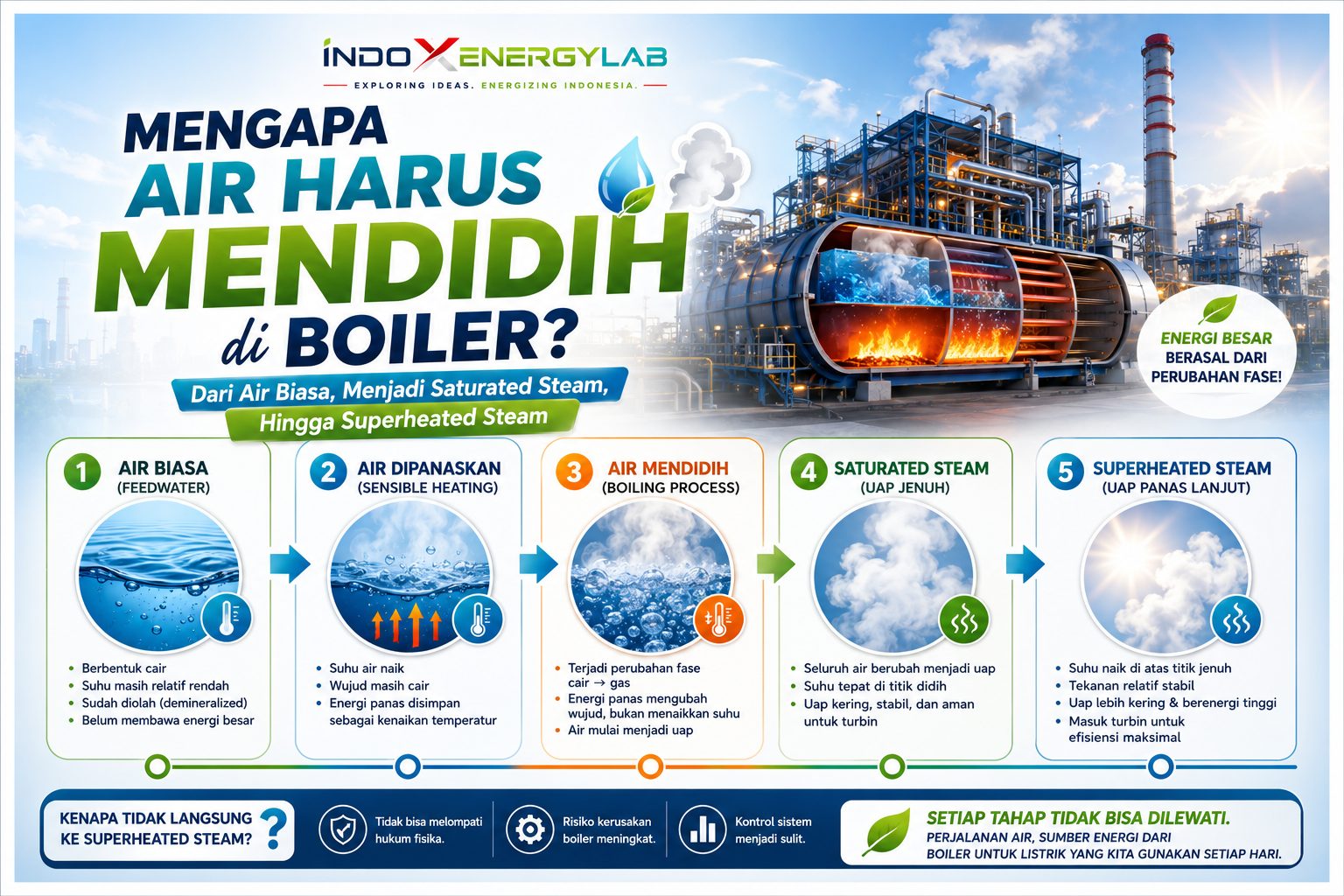
Why Must Water Boil Inside a Boiler?
(From Feedwater to Saturated Steam and Finally Superheated Steam)
In a coal-fired power plant (CFPP), water is much more than just water—it is the medium that carries energy. Its journey through the boiler is not instantaneous but a carefully controlled, step-by-step process: feedwater → boiling water → saturated steam → superheated steam.
This raises a few important questions:
• Why isn’t the water simply heated to an extremely high temperature from the beginning?
• Why must it go through the boiling stage?
• Why is saturated steam necessary before producing superheated steam?
This article explains the entire process in a logical sequence using simple, easy-to-understand language.
Stage 1: Feedwater
The journey begins with ordinary water, known in a power plant as feedwater.
Characteristics of feedwater:
• It is in liquid form.
• It has been treated (demineralized water).
• Its temperature is still relatively low.
• Its pressure has already been adjusted to match the boiler system.
This water must be free of salts, minerals, and impurities because these substances can damage boiler tubes.
At this stage, however, the water has not yet stored a significant amount of energy.
Stage 2: Heating the Water (Sensible Heating)
Once inside the boiler, the feedwater begins to absorb heat.
During this stage:
• The water temperature rises.
• It remains in the liquid state.
• Thermal energy is stored as an increase in temperature.
This process is called sensible heating because:
• The temperature increase can be measured.
• A thermometer continues to show a rising temperature.
Although the water becomes very hot, hot liquid water alone is still not effective for driving a steam turbine.
Stage 3: Boiling (Phase Change)
When the water reaches its boiling point (which depends on its pressure), something important happens.
Instead of continuing to increase in temperature:
• Bubbles begin to form.
• The water starts changing from liquid to vapor.
• The added heat no longer raises the temperature—it changes the water’s phase.
This is the boiling process.
Boiling is a crucial stage because:
• A large amount of energy begins to be stored.
• The liquid water starts transforming into steam.
Stage 4: Saturated Steam
Once all the liquid water has been converted into steam and the steam is exactly at its saturation temperature, it becomes saturated steam.
Characteristics of saturated steam:
• No liquid water remains.
• Temperature and pressure are directly related.
• It exists precisely at the boundary between liquid and vapor.
Why is this stage important?
• It ensures the steam is dry enough.
• It provides safer operating conditions for the turbine.
• It serves as the fundamental design reference for boiler operation.
Without saturated steam, producing superheated steam would not be possible.
Stage 5: Superheated Steam
After saturated steam is produced, it is heated even further.
During this stage:
• The steam temperature rises above the saturation temperature.
• The pressure remains relatively constant.
• The steam’s energy content increases significantly.
This is known as superheated steam.
Superheated steam offers several important advantages:
• It is much drier.
• It is less likely to condense inside the turbine.
• It improves overall power plant efficiency.
This is the type of steam typically supplied to turbines in modern coal-fired power plants.
Why Can’t Water Be Heated Directly into Superheated Steam?
The answer is simple:
Because the laws of physics don’t allow it.
Water must follow this sequence:
1. Be heated.
2. Reach its boiling point.
3. Become saturated steam.
4. Be further heated into superheated steam.
Skipping these steps would result in:
• System instability
• Increased risk of boiler damage
• Difficulties in controlling boiler operation
The Energy Transformation Inside a Boiler
In simple terms, the process looks like this:
• Feedwater → low energy
• Hot water → increasing energy
• Boiling water → energy used for phase change
• Saturated steam → stable steam
• Superheated steam → maximum usable steam energy
Every stage is essential and cannot be skipped.
A Simple Analogy
Imagine preparing to ride a motorcycle.
• Feedwater = the motorcycle is turned off.
• Hot water = the engine is running but the bike is still stationary.
• Saturated steam = the motorcycle starts moving.
• Superheated steam = the motorcycle accelerates at full speed.
Power plants use superheated steam because it allows the turbine to operate at maximum efficiency.
Conclusion
Water must boil inside a boiler because:
• The greatest amount of energy is stored during the phase change from liquid to steam.
• Steam—not liquid water—is what drives the turbine.
Water must first become saturated steam because it:
• Ensures the steam is sufficiently dry.
• Protects the turbine from moisture damage.
• Provides the foundation for the superheating process.
Finally, the steam is converted into superheated steam to:
• Maximize power plant efficiency.
• Extend the service life of critical equipment.
• Produce electricity more reliably and consistently.
The journey of water inside a boiler is a fascinating example of how fundamental principles of physics support the operation of modern power generation systems.