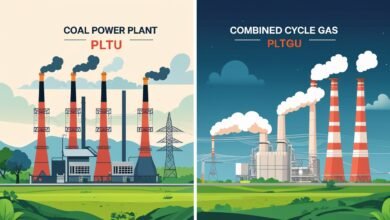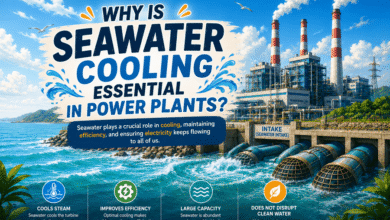
What Is the Role of Water in a Coal-Fired Power Plant (CFPP)?
When people hear the term Coal-Fired Power Plant (CFPP), they often picture towering smokestacks, white steam plumes, coal, and massive machinery. But there’s one crucial element that many people overlook—even though it’s one of the main actors inside the plant.
Yes… water.
Water is one of the hardest-working “employees” in a power plant. Without it, a CFPP would be like a human body without blood—it simply couldn’t function. Water isn’t just stored in tanks as a backup supply; it’s involved in nearly every stage of electricity generation.
In this article, we’ll explore:
• Why water is essential in a coal-fired power plant
• What water is used for
• How water changes form throughout the process
• Why boiler water must be ultra-pure
• How water helps spin the turbine
• What happens if the water becomes contaminated
• The differences between boiler water, cooling water, and service water
• A beginner-friendly explanation that’s still useful for engineering students
Let’s get started!
1. Why Is Water So Important in a Coal-Fired Power Plant?
Before diving into the technical details, here’s one key fact:
A coal-fired power plant converts thermal energy into mechanical energy, and then into electrical energy.
The best medium for transporting heat is… water.
Why water?
• Easily available
• Relatively inexpensive
• Safe to handle
• Excellent at carrying large amounts of heat
• Can change phase (liquid → steam → liquid)
• Highly effective for both boilers and turbines
Water isn’t just a liquid—it is both a heat-transfer medium and the working fluid that drives the turbine.
Inside a power plant, water goes on an incredible journey. It enters as cool water, is heated into high-pressure steam, powers the turbine, cools back into liquid, and repeats the cycle over and over again.
This continuous process is called the steam cycle.
2. The Three Main Functions of Water in a Power Plant
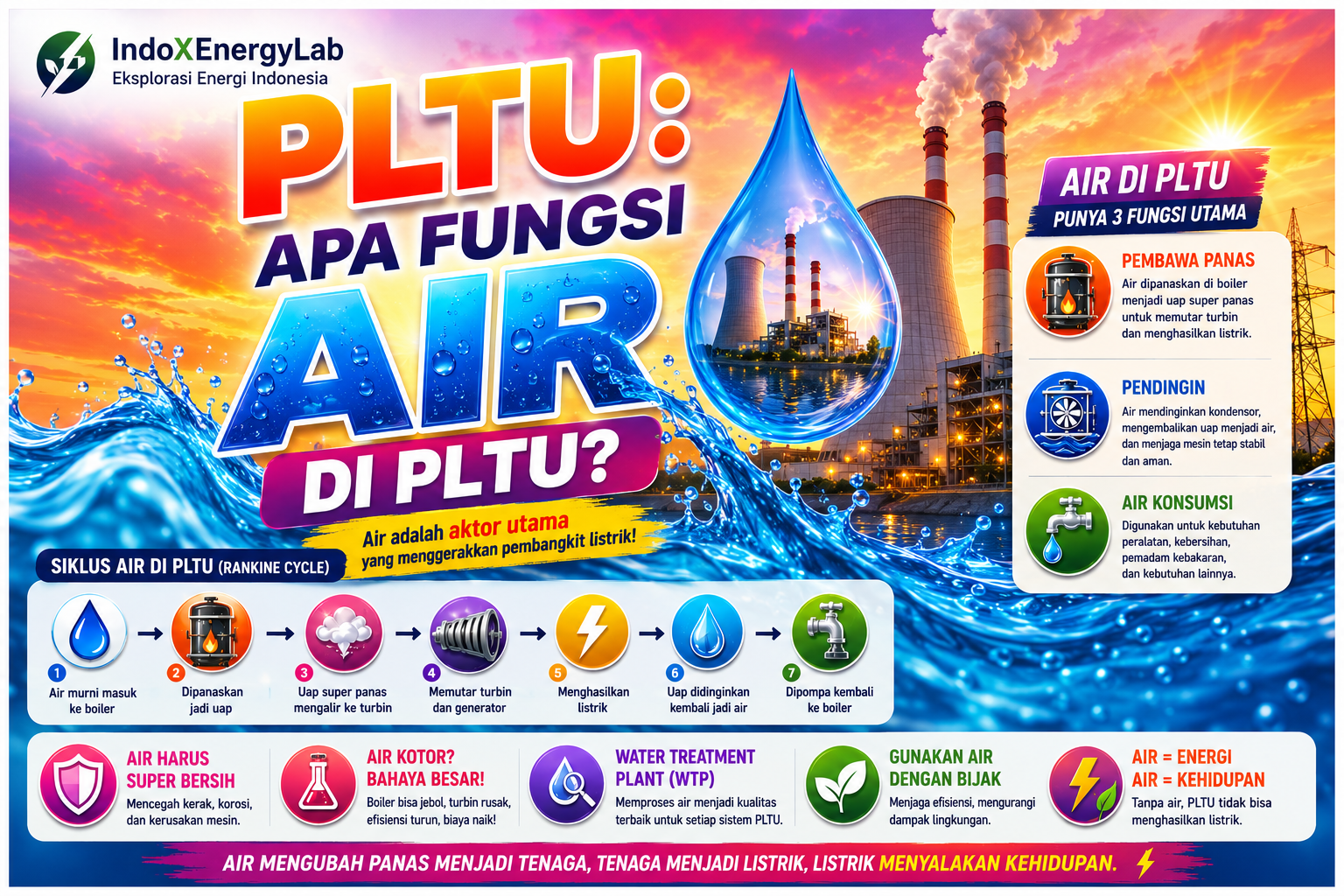
Water serves three primary purposes.
A. Heat Transfer Medium (Boiler Feed Water → Steam)
Boiler feed water is heated inside the boiler until it becomes superheated steam.
This steam:
• Drives the steam turbine
• Converts thermal energy into mechanical energy
• Enables the generator to produce electricity
Without water:
No water → no steam → no turbine rotation → no electricity.
In many ways, water is the plant’s second fuel, after coal.
B. Cooling Medium (Cooling Water System)
A power plant doesn’t only generate heat—it also needs to remove excess heat.
Without proper cooling, equipment could:
• Overheat
• Become damaged
• Fail catastrophically in extreme situations
Cooling water is responsible for:
• Cooling the condenser
• Condensing exhaust steam back into water
• Maintaining stable operating temperatures
• Supporting continuous operation
Cooling water usually does not mix with boiler water. Instead, heat is transferred through large metal tubes inside the condenser.
C. Service Water
Water is also used for many auxiliary purposes, including:
• Equipment cleaning
• Fire protection systems
• Washdown operations
• Domestic use (offices, toilets, pantries)
• HVAC cooling systems
A power plant is like a small city, requiring water for numerous everyday operations.
3. How Does Water Help Generate Electricity?
Here’s a simplified version:
1. Water is heated into steam.
2. High-pressure steam flows rapidly.
3. The steam pushes the turbine blades.
4. The turbine rotates.
5. The rotating turbine drives the generator.
6. The generator produces electricity.
7. Electricity is delivered to homes, schools, and industries.
Simple in concept.
Behind the scenes, however, complex systems ensure the water remains clean, pressure remains stable, and temperatures stay within safe limits.
4. The Water Cycle Inside a Power Plant
Water continuously circulates through the plant in a repeating loop:
1. Demineralized water enters the boiler.
2. It is preheated in the economizer.
3. It enters the steam drum.
4. Steam passes through the superheater.
5. Superheated steam drives the turbine.
6. Exhaust steam enters the condenser.
7. Steam condenses back into water.
8. Pumps return the water to the boiler.
This closed process is known as the Rankine Cycle.
Think of it like a water park:
Water flows down → gets pumped back up → flows down again → repeats continuously.
5. Why Must Boiler Water Be Extremely Pure?
This is one of the most critical aspects of power plant operation.
Boiler water must contain virtually no:
• Minerals
• Dissolved metals
• Salts
• Dirt
• Undesirable ions
Why?
Impurities can cause:
• Scale formation inside boiler tubes
• Corrosion
• Tube leakage
• Turbine damage
• Lower thermal efficiency
• Increased coal consumption
• In severe cases, boiler failure
Therefore, boiler feed water must first become Demineralized Water (DM Water).
Typical treatment processes include:
• Filtration
• Reverse Osmosis (RO)
• Ion exchange demineralization
• Degasification
• Mixed-bed polishing
6. Boiler Water vs. Cooling Water vs. Service Water
These different water systems often confuse beginners.
A. Boiler Feed Water (BFW)
• Converted into steam
• Highest purity
• Mineral-free
• Drives the turbine
B. Cooling Water (CW)
• Does not require ultra-high purity
• Removes heat from the condenser
• Often sourced from rivers, lakes, or seawater
C. Service Water / Raw Water
Used for:
• Cleaning
• Fire protection
• Toilets
• General plant utilities
Each serves a completely different purpose.
7. What Happens If Water Quality Is Poor?
Poor water quality can lead to serious problems.
Boiler Tube Failure
Dirty water creates scale deposits.
Scale reduces heat transfer, causing localized overheating and possible tube rupture.
Turbine Damage
Water droplets carried into the turbine (steam carryover) can erode turbine blades.
Reduced Plant Performance
Poor water quality increases fuel consumption and operating costs.
Lower Efficiency
Just 1 mm of scale can reduce boiler efficiency by approximately 5%.
Greater Environmental Impact
Lower efficiency means more coal must be burned, resulting in higher emissions.
This is why the Water Treatment Plant (WTP) is one of the most important support systems in any power plant.
8. Water Treatment Plant (WTP): Preparing Water for Use
The Water Treatment Plant acts as the facility’s “water factory.”
It prepares water for:
• Boilers
• Cooling systems
• General plant services
• Fire protection
• Turbine operation
A typical WTP includes:
• Water intake
• Screening filters
• Clarifiers
• Sand filters
• Activated carbon filters
• Reverse Osmosis units
• Mixed-bed polishers
• Chemical dosing systems
The objective is simple:
Deliver water that meets the quality requirements of each individual system.
9. How Does Steam Drive the Turbine?
Liquid water doesn’t directly rotate the turbine.
Instead, water is converted into superheated steam, typically at:
• Around 170 bar
• Approximately 540°C
This high-pressure steam strikes the turbine blades with tremendous force.
As a result:
• The turbine rotates at approximately 3,000 rpm (for 50 Hz systems).
• The generator produces hundreds of megawatts of electricity.
If the steam contains too much moisture, turbine blades may suffer:
• Erosion
• Pitting
• Cracking
Maintaining high steam quality is therefore essential.
10. Cooling Systems: Removing Waste Heat
After leaving the turbine, steam must be converted back into water.
The process works like this:
• Exhaust steam enters the condenser.
• Cooling water flows through condenser tubes.
• Steam releases heat.
• Steam condenses back into liquid water.
The condenser functions much like a giant air conditioner.
Two common cooling methods are:
A. Once-Through Cooling (OTC)
Uses water directly from a river, lake, or sea.
B. Cooling Tower
Recirculates cooling water while rejecting heat through evaporation.
Both systems require enormous quantities of water.
11. How Much Water Does a Coal-Fired Power Plant Use?
A large power plant uses an extraordinary amount of water.
For example:
• A 1,000 MW coal-fired power plant may require approximately 40,000–60,000 cubic meters of cooling water per hour.
• Boiler feed water demand is much smaller in volume but requires significantly higher purity.
Water is therefore one of the plant’s most vital resources.
12. Is Water Burned or Consumed?
No.
Water is not burned and is not consumed as fuel.
Instead, it continuously changes phase:
• Liquid → Steam → Liquid
This is why the steam cycle is considered a closed-loop cycle.
Only a small amount of water is lost through:
• Boiler blowdown
• Cooling tower evaporation
• Minor system leakage
The remaining water is continuously recycled.
13. Does Power Plant Water Pollute the Environment?
When operated properly, a power plant should not significantly contaminate surrounding water because:
• Boiler water circulates in a closed system.
• Cooling water mainly transfers heat rather than contaminants.
• Wastewater is treated in a Wastewater Treatment Plant (WWTP) before discharge.
However, pollution risks can arise if there are:
• Equipment leaks
• Chemical spills
• Operational failures
• Poor compliance with operating procedures
14. Conclusion
Water is one of the most essential resources in a coal-fired power plant.
Its roles include:
• Carrying thermal energy
• Producing steam to drive the turbine
• Cooling major equipment
• Maintaining stable operating conditions
• Supporting everyday plant operations
Without water, a coal-fired power plant simply could not operate.
Whether you’re an elementary school student learning about electricity or an engineering student studying power generation, one thing is clear:
Water is the lifeblood of a thermal power plant, quietly working every second to keep electricity flowing to homes, schools, industries, and entire cities.