What Equipment Are Used in a Solar Power System (PLTS)?
Understanding the Important Components of Solar Power Plants
When people see solar panels installed on rooftops or spread across large solar farms, many assume that the panels alone are responsible for generating electricity from sunlight.
In reality, it’s not that simple.
Solar panels are indeed the main component, but a Solar Power System (PLTS – Solar Photovoltaic System) consists of many other pieces of equipment working together.
Think of a solar power system like a soccer team.
The solar panels may be the strikers scoring the goals, but they still need:
• A goalkeeper
• Midfielders
• A coach
• Team strategy
A solar power system works the same way.
To turn sunlight into usable electricity for homes and buildings, several supporting components are required.
In this article, we’ll explore the essential equipment used in a solar power system, from the primary components to the supporting devices that make everything work efficiently.
Main Components of a Solar Power System
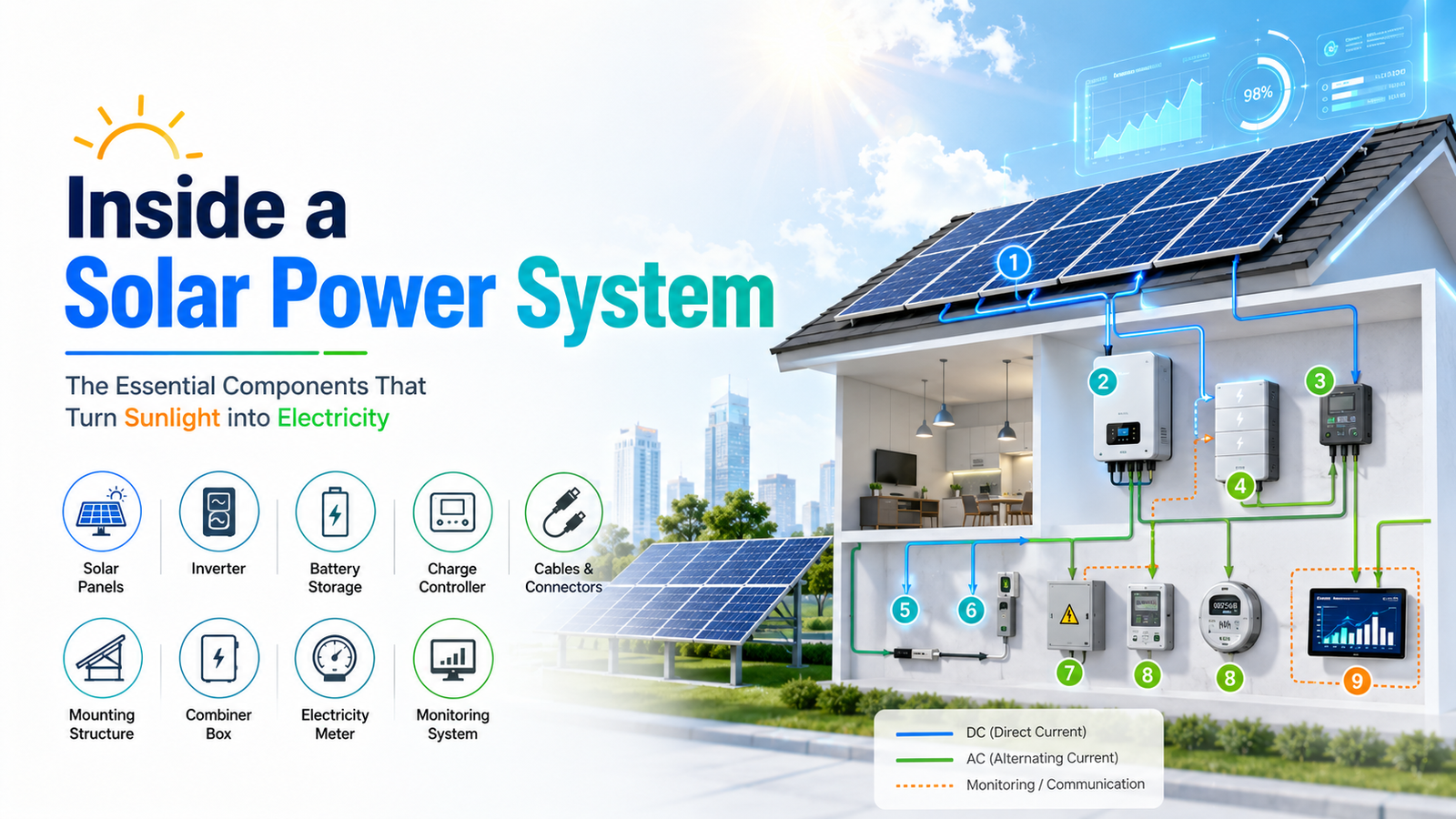
In general, a solar power system consists of the following key components:
1. Solar Panels
2. Inverter
3. Battery Storage
4. Solar Charge Controller
5. Cables and Connectors
6. Mounting Structure
7. Combiner Box
8. Electricity Meter
9. Monitoring System
Each component has a unique function, but all of them work together to generate and deliver electricity effectively.
Let’s take a closer look at each one.
1. Solar Panels
Solar panels are the most recognizable component of a solar power system.
Their primary function is to capture sunlight and convert it into electricity.
A solar panel is actually made up of many smaller solar cells connected together within a single module.
When sunlight strikes the solar cells, a process called the photovoltaic effect occurs, converting solar energy into electrical energy.
The electricity produced by solar panels is typically Direct Current (DC) electricity.
Solar panels are usually installed in locations that receive maximum sunlight exposure, such as:
• Residential rooftops
• Commercial building rooftops
• Open fields
• Utility-scale solar power plants
Solar panel sizes vary depending on their application.
Residential panels commonly have capacities ranging from 300 to 600 watts per panel.
The more panels installed, the greater the amount of electricity that can be generated.
2. Inverter
Once electricity is generated by the solar panels, it cannot immediately be used by most household appliances.
Why?
Because solar panels produce Direct Current (DC) electricity.
Most household appliances, however, operate using Alternating Current (AC) electricity, including:
• Televisions
• Refrigerators
• Lighting systems
• Computers
This is where the inverter becomes essential.
An inverter converts DC electricity into AC electricity.
Without an inverter, solar-generated electricity would not be compatible with standard household electrical systems.
Common types of solar inverters include:
• String Inverters
• Microinverters
• Hybrid Inverters
Each type offers specific advantages and is suited for different applications.
3. Battery Storage
Not all solar power systems include batteries, but in many applications, battery storage plays an important role.
Batteries store excess electricity generated by solar panels.
The stored energy can then be used during:
• Nighttime
• Cloudy weather
• Periods of high electricity demand
With batteries, solar energy becomes available even when the sun is not shining.
Common battery technologies include:
Lithium-Ion Batteries
These batteries are widely used because they offer:
• Long lifespan
• High efficiency
• Compact size
Lead-Acid Batteries
These batteries are generally less expensive but typically have:
• Shorter service life
• Lower efficiency
Battery storage is commonly used in off-grid and hybrid solar systems.
4. Solar Charge Controller
A solar charge controller regulates the flow of electricity from the solar panels to the battery bank.
Its primary purpose is to protect batteries from issues such as:
• Overcharging
• Excessive discharge
Without a charge controller, batteries can degrade rapidly.
The controller also improves charging efficiency and extends battery life.
Two common types of charge controllers are:
PWM (Pulse Width Modulation)
• Simpler design
• Lower cost
• Suitable for smaller systems
MPPT (Maximum Power Point Tracking)
• More advanced technology
• Higher efficiency
• Commonly used in larger solar installations
5. Cables and Connectors
Although they may seem simple, cables and connectors are critical components of any solar power system.
Cables carry electricity between system components, including:
• Solar panels to inverter
• Inverter to battery
• Inverter to household electrical systems
Solar cables are specially designed to withstand:
• Sunlight exposure
• Rain
• Extreme weather conditions
Specialized connectors are also used to connect solar panels safely and efficiently.
One of the most common connector types is the MC4 connector.
6. Mounting Structure
The mounting structure is the framework that supports and secures the solar panels.
It ensures the panels remain stable and safely positioned.
Mounting structures are typically made from materials such as:
• Aluminum
• Galvanized steel
These materials are selected because they are resistant to:
• Corrosion
• Rain
• UV exposure
The mounting structure also determines the tilt angle of the solar panels.
Proper tilt angles help maximize solar energy production.
If the panels are installed at an incorrect angle, energy output can decrease significantly.
7. Combiner Box
A combiner box is used to combine electrical output from multiple solar panel strings.
In larger solar systems with many panels, electricity from individual strings must be consolidated before entering the inverter.
Combiner boxes typically include protective devices such as:
• Fuses
• Circuit breakers
• Surge protection devices
These safety features protect the system from:
• Overcurrent conditions
• Lightning strikes
• Short circuits
8. Electricity Meter
Electricity meters measure the amount of electricity generated and consumed by the solar power system.
In grid-connected solar systems, meters typically record:
• Solar electricity production
• Household electricity consumption
• Electricity exported to the utility grid
Many modern installations use smart meters, which automatically record and transmit performance data.
This information helps users track system performance and energy savings.
9. Monitoring System
A monitoring system allows users to view the performance of their solar installation in real time.
Through a monitoring platform, users can see:
• How much electricity is being generated
• How much electricity is being consumed
• Whether the system is operating properly
Monitoring systems are often accessible through:
• Smartphone applications
• Computers
• Online dashboards
This technology makes it easier to identify and resolve system issues quickly.
If a fault occurs, operators can take corrective action before it becomes a major problem.
How Do All These Components Work Together?
To better understand the process, let’s look at the basic workflow of a solar power system.
Step 1
Solar panels capture sunlight and generate DC electricity.
Step 2
The electricity flows through cables to the inverter or charge controller.
Step 3
If batteries are included, the charge controller regulates battery charging.
Step 4
The inverter converts DC electricity into AC electricity.
Step 5
The AC electricity powers household appliances and building electrical systems.
All of these processes occur almost instantly.
Why Are So Many Components Needed?
Some people may wonder:
Why does a solar power system require so many different devices?
The answer is simple: each component performs a specific function.
If one component is missing or malfunctioning, the entire system can be affected.
For example:
• Without an inverter, electricity cannot be used by most appliances.
• Without a charge controller, batteries may be damaged.
• Without a mounting structure, solar panels cannot be installed safely.
That is why all of these components must work together as a complete system.
The Future of Solar Power Technology
Solar technology continues to evolve rapidly.
Researchers and energy companies are constantly developing systems that are:
• More efficient
• More affordable
• More durable
Some innovations currently being developed include:
• Thinner solar panels
• Higher-capacity batteries
• Smarter inverters
• Internet-connected monitoring systems
In the future, we will likely see more homes, businesses, and industrial facilities powered by solar energy.
Conclusion
A solar power system is much more than just solar panels.
It consists of various components working together to convert sunlight into usable electricity.
The main equipment found in a solar power system includes:
• Solar panels
• Inverters
• Batteries
• Charge controllers
• Cables and connectors
• Mounting structures
• Combiner boxes
• Electricity meters
• Monitoring systems
Each component plays an important role in ensuring the system operates safely, efficiently, and reliably.
As renewable energy technologies continue to advance, solar power is expected to become one of the world’s most important energy sources.
And perhaps one day, most homes across Indonesia will have solar panels installed on their rooftops, generating clean electricity directly from the sun. ☀️⚡