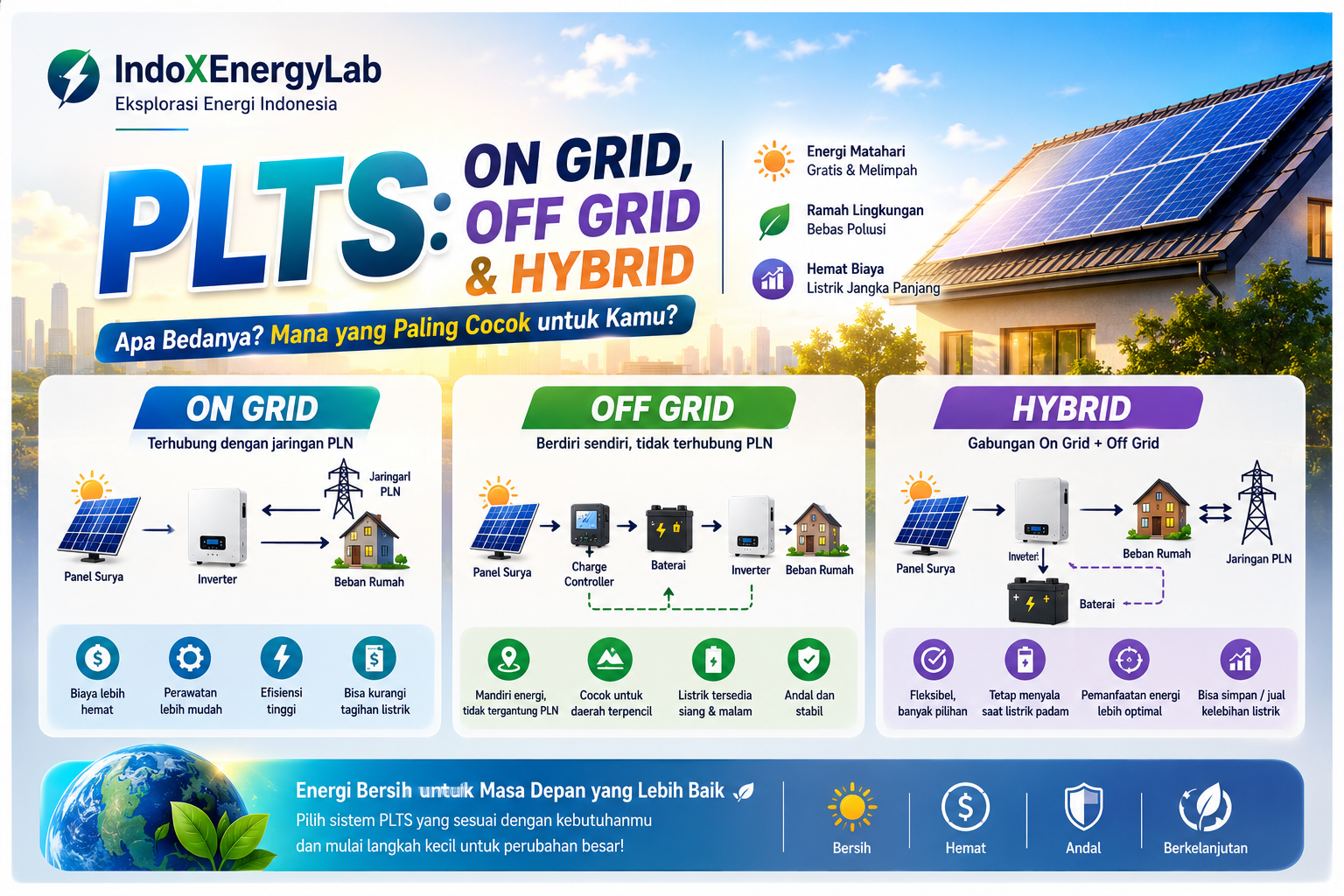
What Are On-Grid, Off-Grid, and Hybrid Solar Power Systems?
Solar energy is becoming increasingly popular around the world, including in Indonesia. One of the most widely used technologies for harnessing solar energy is the Solar Power Plant (PLTS), also known as a solar photovoltaic (PV) system.
You may have seen solar panels installed on rooftops, commercial buildings, or even across large open fields. Those panels are part of a solar power system.
But did you know?
There isn’t just one type of solar power system.
In general, there are three main types of solar PV systems:
– On-Grid Solar PV Systems
– Off-Grid Solar PV Systems
– Hybrid Solar PV Systems
Each system operates differently, offers unique advantages, and is best suited for different applications.
In this article, we’ll explore each type in a simple and easy-to-understand way.
Understanding Solar Power Systems (PLTS)
Before discussing the different types, let’s first understand what a solar power system is.
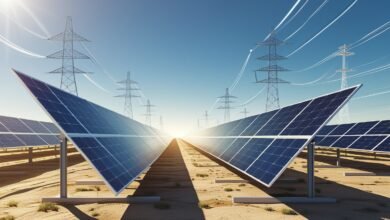
A Solar Power Plant (PLTS) is a power generation system that converts sunlight into electricity using devices known as solar panels or photovoltaic (PV) panels.
The basic process is quite simple:
– Sunlight strikes the solar panels.
– The panels capture the solar energy.
– The energy is converted into electricity.
– The electricity is then used to power electrical appliances.
However, electricity generated by solar panels is Direct Current (DC).
Meanwhile, the electricity used in homes and businesses is typically Alternating Current (AC).
For that reason, an inverter is needed to convert DC electricity into AC electricity.
In general, a solar PV system consists of several major components:
– Solar panels
– Inverter
– Battery (optional)
– Charge controller
– Electrical distribution system
The primary difference between On-Grid, Off-Grid, and Hybrid systems lies in how they connect to the electrical grid and how they store electricity.
What Is an On-Grid Solar PV System?
An On-Grid Solar PV System is directly connected to the public electrical grid.
In Indonesia, this typically means the utility grid operated by PLN.
The electricity generated by the solar panels works together with electricity supplied by the utility.
This system is also commonly called:
– Grid-Tied Solar System
– Grid-Connected Solar System
How an On-Grid Solar System Works
The operating process is generally as follows:
– Sunlight reaches the solar panels.
– The panels generate electricity.
– The inverter converts DC electricity into AC electricity.
– The electricity is immediately used by the building.
– Any excess electricity can be exported to the utility grid.
Conversely, when the solar panels cannot produce enough electricity—such as at night or during cloudy weather—the building simply draws electricity from the utility grid.
In other words, both power sources complement each other.
Common Applications of On-Grid Systems
On-grid systems are commonly installed in:
– Residential homes
– Office buildings
– Shopping malls
– Manufacturing facilities
– Universities
These systems are ideal for locations with reliable grid access.
Advantages of On-Grid Solar Systems
Lower installation costs. Because no batteries are required, installation costs are generally lower.
Lower maintenance requirements.
Battery systems require periodic maintenance and eventual replacement. Without batteries, the overall system is much simpler.
Higher efficiency. Solar energy is used immediately rather than stored.
Lower electricity bills. A properly designed system can significantly reduce electricity purchased from the utility.
Disadvantages of On-Grid Solar Systems
- Cannot operate during utility outages
- Although it may seem surprising, this is intentional.
- When the utility grid loses power, the inverter automatically shuts down for safety reasons to protect utility workers repairing power lines.
- Dependent on the utility grid. Without access to the electrical grid, this system cannot operate independently.
What Is an Off-Grid Solar PV System?
Unlike an On-Grid system, an Off-Grid Solar PV System is completely independent of the utility grid.
It generates and supplies electricity on its own.
For this reason, it is often called a:
Standalone Solar System
Off-grid systems are especially important in areas without access to electricity.
Examples include:
– Remote villages
– Small islands
– Mountainous regions
– Agricultural plantations located far from cities
How an Off-Grid Solar System Works
The process differs slightly:
– Solar panels generate electricity.
– Electricity is stored in batteries.
– The inverter converts battery power into AC electricity.
– The electricity is used throughout the day and night.
In this system, batteries serve as energy storage.
Since the sun only shines during the daytime, electricity must be stored for use:
– At night
– During cloudy weather
– During rainy conditions
Additional Components in Off-Grid Systems
Off-grid systems typically include:
– Battery bank
– Charge controller
– Inverter
– Solar panels
The charge controller regulates battery charging and prevents overcharging.
Advantages of Off-Grid Solar Systems
- Independent of the electrical grid. These systems can operate anywhere, even without utility service.
- Energy independence. All electricity is generated from solar energy.
- Ideal for remote areas. They provide an effective solution where extending the electrical grid is impractical.
Disadvantages of Off-Grid Solar Systems
- Higher installation costs. Battery systems represent a significant portion of the total investment.
- Battery replacement. Batteries have a limited service life. Depending on the battery type, replacement is typically required every 5 to 10 years.
- Careful system design is essential. If battery capacity is undersized, stored energy may run out before sunrise.
- Proper system planning is therefore critical.
What Is a Hybrid Solar PV System?
A Hybrid Solar PV System combines two technologies:
– On-Grid Solar
– Off-Grid Solar
This means the system:
– Connects to the utility grid
– Includes battery storage
Because of this combination, hybrid systems are often considered the most flexible option.
How a Hybrid Solar System Works
The exact operation depends on system design, but generally follows this process:
– Solar panels generate electricity.
– Electricity is first used by the home or facility.
– Any excess electricity can either:
– Be stored in batteries
– Be exported to the utility grid
– When additional electricity is needed, power can be supplied by:
– Batteries
– The utility grid
In other words, hybrid systems have multiple available energy sources.
Common Applications of Hybrid Systems
Hybrid systems are commonly installed in:
– Modern homes
– Villas
– Resorts
– Small data centers
– Critical facilities
These locations require a more reliable and resilient power supply.
Advantages of Hybrid Solar Systems
Greater flexibility
The system automatically selects the most appropriate power source.
Backup power during outages
Because batteries are included, electricity remains available even when the utility grid fails.
Better utilization of solar energy
Solar electricity can be:
– Used immediately
– Stored for later use
– Exported to the utility grid
Disadvantages of Hybrid Solar Systems
Higher costs
Hybrid systems require:
– Battery storage
– Specialized hybrid inverters
– More sophisticated control systems
More complex installation
Proper planning and experienced technicians are essential.
Comparing On-Grid, Off-Grid, and Hybrid Solar Systems
The following comparison summarizes the three systems.
| System | Connected to the Utility Grid | Uses Battery Storage | Best Suited For |
| On-Grid | Yes | No | Urban homes, commercial buildings |
| Off-Grid | No | Yes | Remote villages and off-grid locations |
| Hybrid | Yes | Yes | Modern homes and critical facilities |
Why Is Solar Power Becoming More Popular?
Solar energy has grown rapidly worldwide over the past decade.
Several factors contribute to this growth.
Sunlight is free
The sun provides an abundant and free source of energy.
Indonesia, located near the equator, enjoys excellent solar resources throughout most of the year.
Environmentally friendly
Solar power produces no:
– Smoke
– Air pollution
– Carbon emissions during operation
As a result, it plays an important role in reducing greenhouse gas emissions and combating climate change.
Solar panels have become much more affordable
Solar panels were once considered very expensive.
However, prices have declined dramatically over the past 10 to 20 years, making solar technology much more accessible.
Supports the future energy transition
Many countries are shifting toward renewable energy sources such as:
– Solar
– Wind
– Hydropower
– Biomass
Solar PV has become one of the leading technologies driving the global energy transition.
Challenges of Solar Power Development
Despite its many advantages, solar power also faces several challenges.
Intermittency
Solar energy is not available all the time.
Generation decreases during:
– Nighttime
– Cloudy weather
– Rainy conditions
For this reason, solar systems often require batteries or support from the electrical grid.
High upfront investment
Although operating costs are low, initial installation costs can still be significant for some homeowners and businesses.
Technical expertise
A solar PV system must be carefully designed to achieve optimal performance and long-term reliability.
The Future of Solar Power in Indonesia
Indonesia has tremendous solar energy potential.
Several studies estimate that the country’s solar resource could reach thousands of gigawatts.
However, only a small portion of that potential has been utilized.
In the future, solar power is expected to expand across many sectors, including:
– Residential homes
– Industrial facilities
– Commercial buildings
– Industrial parks
– Data centers
– Agriculture
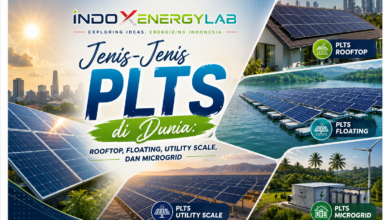
Rooftop solar installations are already becoming increasingly common in urban areas.
Conclusion
Solar PV systems convert sunlight into electricity.
There are three primary types of solar power systems:
On-Grid Solar PV
Connected directly to the utility grid and ideal for urban areas.
Off-Grid Solar PV
Operates independently without grid access and is best suited for remote locations.
Hybrid Solar PV
Combines both on-grid and off-grid technologies, offering maximum flexibility.
Each system has its own strengths and limitations.
The best choice depends on several factors, including:
– Location
– Electricity demand
– Investment budget
– Intended application
With Indonesia’s enormous solar energy potential, solar PV can become one of the country’s most important energy solutions for the future.
In the coming years, we may see even more rooftops on homes, schools, and commercial buildings covered with solar panels.
Solar energy is no longer the energy of the future.
Solar energy is the energy of today.