PLTU vs PLTGU: Understanding Two Major Types of Power Plants
Electricity has become an essential part of our daily lives. From the moment we wake up until we go to bed, almost everything we do depends on electricity.
But have you ever wondered:
“Where does electricity actually come from, and how is it generated?”
If you’re starting to learn about energy, you’ll often come across two important terms:
• PLTU
• PLTGU
At first glance, they may sound similar because both are power plants. However, they operate in quite different ways.
This article explains what PLTU and PLTGU are, how they work, and what makes them different—all in a simple, easy-to-understand, yet technically accurate way.
Whether you’re an elementary school student, a high school learner, or a university student exploring the energy sector, this guide is for you.
1. Understanding PLTU: Steam Power Plant
What Is a PLTU?
PLTU (Pembangkit Listrik Tenaga Uap) translates to a Steam Power Plant.
As the name suggests, a PLTU uses steam as the primary force to spin a turbine and generate electricity.
The heat source is usually obtained from:
• Coal
• Biomass (in some cases)
• Other solid fuels
In Indonesia, however, coal-fired PLTUs are by far the most common.
2. How Does a PLTU Work? (Simple Version)
The basic process is:
1. Coal is burned inside a boiler.
2. The heat converts water into high-pressure steam.
3. The steam spins a steam turbine.
4. The turbine rotates a generator.
5. The generator produces electricity.
After passing through the turbine:
• The steam is cooled.
• It condenses back into water.
• The water is reused in the system.
This process is known as a closed-cycle system.
3. Main Components of a PLTU
Several major components work together in a steam power plant:
• Boiler – heats water into steam
• Steam Turbine – driven by high-pressure steam
• Generator – converts mechanical energy into electricity
• Condenser – cools steam back into water
• Cooling System – often uses seawater or cooling towers
These components operate continuously to provide electricity around the clock.
4. Characteristics of a PLTU
A PLTU typically has the following characteristics:
• Suitable for large and stable power demand
• Designed for long-term continuous operation
• Produces large amounts of electricity
• Requires a long startup time
Because of these characteristics, PLTUs are commonly used as baseload power plants.
5. Understanding PLTGU: Combined Cycle Gas and Steam Power Plant
What Is a PLTGU?
PLTGU (Pembangkit Listrik Tenaga Gas dan Uap) translates to a Combined Cycle Gas and Steam Power Plant.
A PLTGU combines two power-generation technologies:
1. Gas turbine generation
2. Steam turbine generation
This is why it is commonly known as a Combined Cycle Power Plant (CCPP).
6. How Does a PLTGU Work? (Simple Version)
The process consists of two stages.
Stage 1: Gas Turbine Cycle
1. Natural gas is burned in a combustion chamber.
2. The combustion produces high-temperature, high-pressure gases.
3. These gases spin a gas turbine.
4. The gas turbine drives the first generator.
At this stage, electricity is already being produced.
Stage 2: Steam Turbine Cycle
Instead of being wasted, the hot exhaust gases are utilized further.
The exhaust gases:
• Flow into an HRSG (Heat Recovery Steam Generator)
• Heat water to produce steam
The steam then:
• Spins a steam turbine
• Drives a second generator
As a result, electricity is generated twice from the same fuel source.
7. Main Components of a PLTGU
Key components include:
• Gas Turbine
• Heat Recovery Steam Generator (HRSG)
• Steam Turbine
• Generator
• Cooling System
Because it combines two cycles, a PLTGU is generally more complex than a PLTU.
8. Characteristics of a PLTGU
PLTGUs are known for:
• High efficiency
• Fast startup capability
• Lower emissions
• Operational flexibility
Because of these advantages, PLTGUs are often used for:
• Intermediate load demand
• Peak load demand
9. Similarities Between PLTU and PLTGU
Despite their differences, both power plants share several common features:
• Both generate electricity
• Both use turbines
• Both use generators
• Both require cooling systems
• Both convert thermal energy into mechanical energy and then into electrical energy
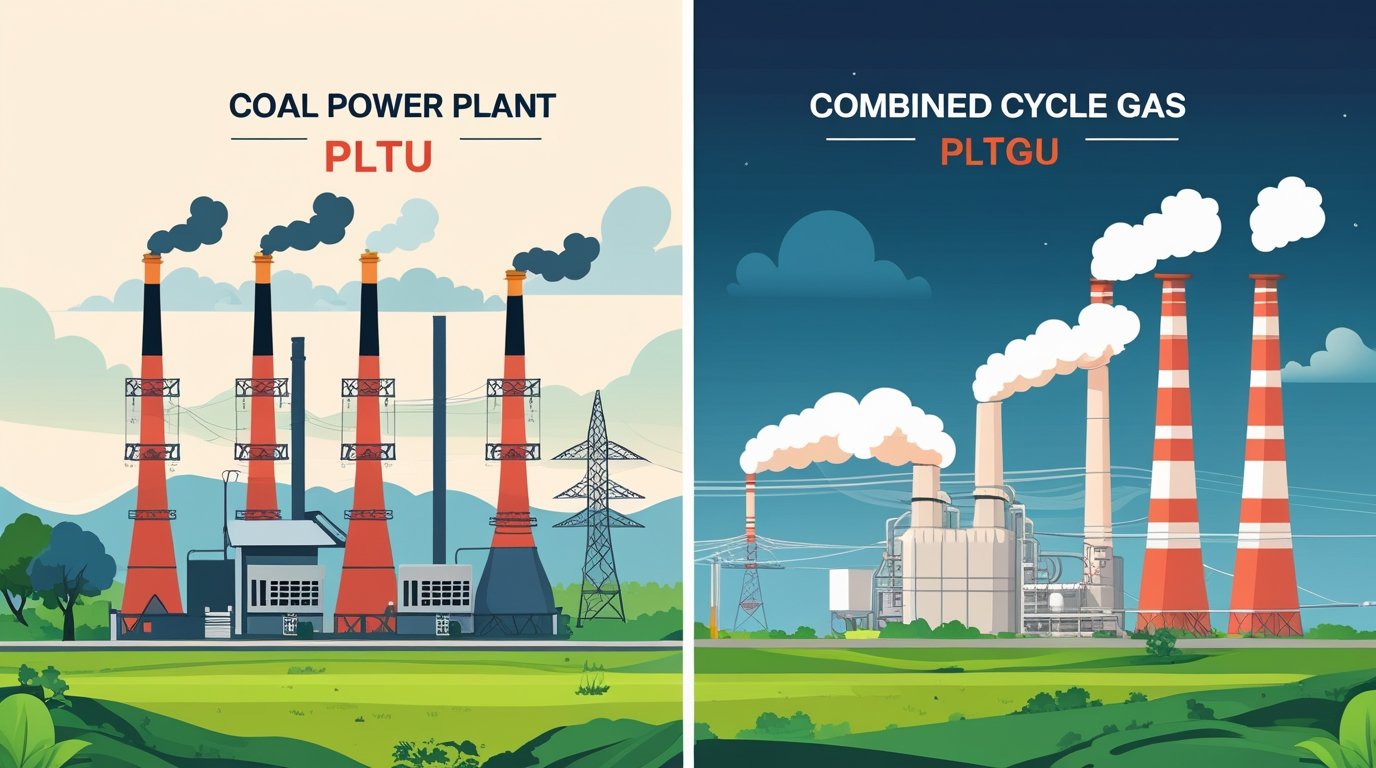
10. Key Differences Between PLTU and PLTGU
1. Fuel Type
PLTU : Coal
PLTGU : Natural gas
2. Operating Cycle
PLTU : Single cycle (steam only)
PLTGU : Combined cycle (gas + steam)
3. Efficiency
PLTU : Lower efficiency
PLTGU : Higher efficiency
4. Startup Time
PLTU : Slow (hours or even days)
PLTGU : Fast (minutes to hours)
5. Environmental Impact
PLTU : Higher emissions
PLTGU : Lower emissions
6. Operational Flexibility
PLTU : Best for stable, continuous loads
PLTGU : Better for fluctuating demand
11. Why Do We Still Need PLTUs?
Even though PLTGUs are cleaner and more efficient, PLTUs remain important because:
• Coal resources are still abundant in many countries.
• Fuel costs are often relatively low.
• They provide stable baseload power.
• Existing infrastructure is already in place.
For many developing economies, PLTUs continue to play a significant role in maintaining energy security.
12. The Future of PLTU and PLTGU
Looking ahead:
• PLTUs are expected to become more efficient and environmentally friendly through technology upgrades and emission-control systems.
• PLTGUs are likely to serve as a bridge technology during the transition toward renewable energy.
Both technologies are expected to remain important contributors to power systems for years to come.
13. Conclusion
In summary:
PLTU (Steam Power Plant)
• Uses steam generated from fuel combustion
• Suitable for large, stable electricity demand
• Reliable baseload power source
PLTGU (Combined Cycle Gas and Steam Power Plant)
• Uses both gas and steam turbines
• More efficient and flexible
• Produces lower emissions
While their technologies and operating characteristics differ, both share the same goal:
Providing the electricity that powers our daily lives.
Understanding the differences between PLTU and PLTGU helps us better appreciate how electricity is generated and how various technologies contribute to Indonesia’s energy future and ongoing energy transition. ⚡🌍