Energy Marshal: Guardian of Energy Security in the Project World
Sounds Cool, But What Exactly Is It
⚡ 1. “Energy Marshal” — Sounds Cool, But What Exactly Is It?
Have you ever heard the terms Fire Marshal or Safety Officer in a construction project?
Well, now there is another role that is becoming more common: Energy Marshal.
At first glance, the name might sound like an “energy engineer” or “electrical expert.” However, the main responsibility of an Energy Marshal is not about saving electricity.
An Energy Marshal (EM) is more focused on ensuring the safety of everything related to energy and electrical systems in a project area.
Imagine a large project — such as the construction of a data center, coal power plant (PLTU), gas power plant (PLTG), or industrial facility — with hundreds of work areas, electrical cables, generators, panels, batteries, inverters, and UPS systems.
A special role is needed to ensure that all energy-related activities are:
• Safe
• Controlled
• Properly managed
• Free from potential hazards
That role is the Energy Marshal (EM).
2. Why Does the Construction Industry Need an Energy Marshal?
Imagine a large construction site:
Cranes are moving, workers are welding, generators are running, floodlights are everywhere, and electrical cables are crossing access areas.
Energy exists everywhere:
• Electricity
• Fuel
• Compressed air
• Heat from machines
If energy is not properly controlled, hazards can happen anytime:
• Electrical leakage → someone gets electrocuted.
• Overloaded cables → fire risk.
• Poor generator grounding → abnormal voltage reaches other areas.
• Lock-Out/Tag-Out (LOTO) violations → workers get injured.
This is where the Energy Marshal comes in.
They are the “guardian of safe energy use” — the person responsible for ensuring that all energy activities are controlled, safe, and follow proper procedures.
3. Main Responsibilities of an Energy Marshal in the Field
The role of an Energy Marshal may vary depending on the project location and phase, but generally includes:
🔹 A. Monitoring Temporary Energy Distribution
Construction projects usually use temporary power sources from generators or temporary electrical panels.
The Energy Marshal will:
• Check cable routes from power sources to loads (lighting, tools, equipment chargers, etc.).
• Ensure MCCB/MLO protection matches the electrical capacity.
• Control panel layout, grounding, and energy signage.
In a data center project, for example, the EM must also understand:
• Rack power points
• UPS systems
• Dual-feed power supply (A/B supply)
🔹 B. Enforcing Lock Out Tag Out (LOTO) System
This is one of the most important parts of an Energy Marshal’s job.
They ensure that all energy-related work follows proper LOTO procedures.
Example:
A technician wants to open an electrical panel or replace a breaker.
The Energy Marshal ensures:
1. The panel is switched OFF.
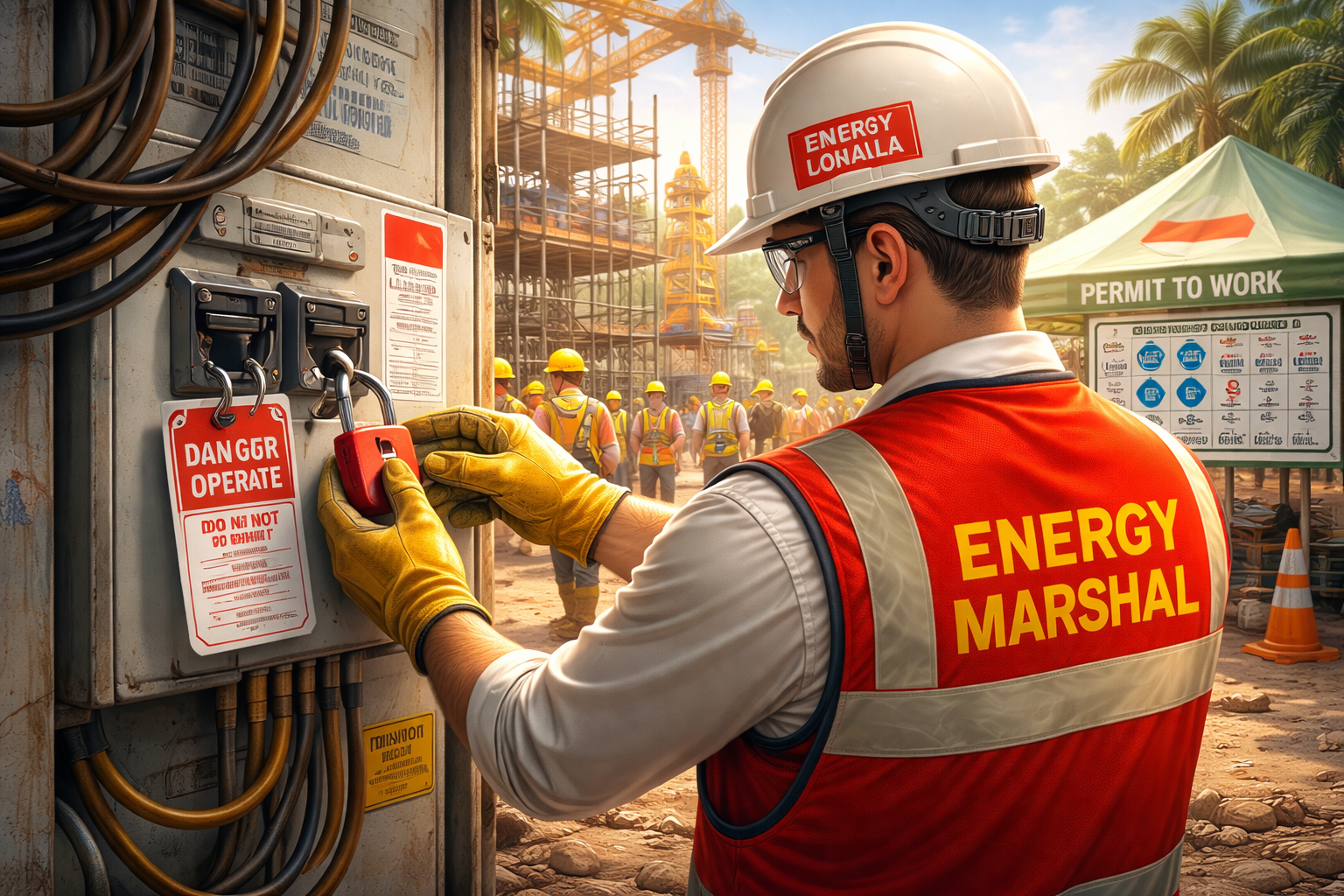
2. The energy source is locked using a red padlock.
3. A tag with worker identification is installed.
4. All keys are controlled by the Energy Marshal or authorized supervisor.
The purpose?
To prevent anyone from accidentally turning the system back on while someone is still working.
That is why the red LOTO padlock has become one of the main symbols of an Energy Marshal — a warning sign that represents danger under control.
🔹 C. Energy Area Audits
Energy Marshals regularly inspect project areas to ensure:
• No cables are placed carelessly.
• Electrical connections have proper insulation.
• Electrical panels are securely closed and locked.
• Energy tagging and labeling are complete (example: 220V, 380V, DC supply).
• No illegal tapping or unauthorized connections exist.
If abnormalities are found, the EM may issue:
• Energy Observation Report
• Unsafe Energy Finding
Then they coordinate with the safety team and engineers for corrective actions.
🔹 D. Energy Safety Education and Awareness
Energy Marshals also educate workers about:
• Stored energy hazards
• Importance of LOTO
• Proper handling of cables and electrical equipment
• Electrical PPE usage (rubber gloves, dielectric safety shoes, etc.)
Usually, weekly Energy Safety Talks are conducted by the EM — relaxed in style, but serious in purpose.
🔹 E. Documentation and Reporting
Every energy-related activity must be recorded:
• Who performed the work
• Which panel was isolated
• Start and finish time
• Key handover records
• Safety checklist
The Energy Marshal manages this through:
• Logbooks
• Safety management software
If there is an electrical incident or near miss, the EM also participates in the investigation.
4. Difference Between Energy Marshal and Electrical Engineer
This often creates confusion.
Both work around electricity, but their roles are different.
| Aspect | Electrical Engineer | Energy Marshal |
| Focus | Electrical design, installation, commissioning | Energy safety and control during activities |
| Goal | System works according to technical specifications | Energy is controlled and workers remain safe |
| Activities | Designing SLD, installing cables, setting breakers | Monitoring LOTO, auditing areas, verifying permits |
| Final Result | Electricity flows and systems operate | Energy is controlled and people are protected |
So, an Energy Marshal is not a competitor to an engineer.
They are actually a safety partner who protects the energy side of the project.
5. Energy Marshal and Permit to Work (PTW) System
Energy Marshals are usually part of the Permit to Work (PTW) system in major projects.
Before any energy-related work begins, permission must be approved by:
• Supervisor
• Safety Officer
• Energy Marshal
Examples:
• Working on an energized panel → requires Electrical Isolation Permit.
• Working near busbars → requires EM verification.
• High voltage testing → EM must be present at the location.
In simple terms:
The Energy Marshal is the gatekeeper before energy is released for work.
6. Field Example
Imagine you are working on a data center construction project in Cikarang.
Today, the team wants to activate the UPS system.
Before starting, the Energy Marshal arrives:
1. Checks the main breaker status → OFF position.
2. Installs a red padlock and technician identification tag.
3. Marks the work area with safety tape.
4. Completes the Energy Isolation Checklist.
5. Informs the Control Room to prevent switching activities.
After the work is completed and the area is confirmed safe, the EM removes the lock according to procedure.
The process may look complicated, but without it, a fatal accident could happen.
One mistake — electrical current can become deadly within seconds.
7. Skills Required to Become an Energy Marshal
To perform the role effectively, an Energy Marshal needs a combination of technical knowledge and safety mindset.
🔧 Technical Skills:
• Understanding industrial electrical systems (AC/DC, single phase, three phase).
• Reading Single Line Diagrams (SLD).
• Understanding grounding and protection systems.
• Familiarity with LOTO, PTW, and energy isolation procedures.
• Understanding stored energy hazards (pneumatic, mechanical, electrical, thermal).
🧠 Soft Skills:
• Strong enough to stop unsafe work.
• Detail-oriented and consistent with documentation.
• Good communication skills because EM connects operations, safety teams, and contractors.
• Patient, because sometimes technicians want to work faster while EM must ensure safety comes first.
8. Energy Marshal in the Safety Organization Structure
A typical large project structure:
Project Manager
│
├── HSE Manager
│ ├── Safety Officer
│ ├── Fire Marshal
│ └── Energy Marshal
│
└── Construction / Electrical Team
Energy Marshal works alongside Safety Officers but focuses specifically on energy-related risks.
If Safety Officers monitor general hazards (working at height, hot work, confined space),
the Energy Marshal focuses on electrical hazards and stored energy risks.
9. Tools and Symbols of an Energy Marshal
Every profession has its own important tools.
For an Energy Marshal, common tools include:
Tool / Symbol Function
🔴 Red LOTO Padlock Locks energy sources to prevent activation
🏷️ Tag Name Identifies the person working
⚡ Multimeter & Tester Confirms no voltage before work
📋 Checklist / Logbook Records isolation and inspection activities
🧤 Rubber gloves & dielectric safety shoes Protection from electrical shock
🪪 Energy Marshal ID Official authority identification
Usually, Energy Marshals wear special red vests or have an “Energy Marshal” label on their helmets so everyone can easily identify them.
10. Challenges in the Field
Being an Energy Marshal is not an easy job.
Common challenges include:
1. Project Time Pressure
Sometimes operational teams want to move quickly, but EM must verify safety procedures first.
2. Lack of Energy Awareness
Many people underestimate electrical hazards, even though they can be fatal.
3. Contractor Coordination
Large projects involve multiple vendors. EM must ensure everyone follows the same safety standards.
4. Complex Energy Systems
In data centers, for example, there are:
• Dual-feed systems
• Busways
• UPS
• Batteries
• Solar PV systems
The EM must understand how all these systems work.
But this is also where the pride comes from.
Because the Energy Marshal’s job is about protecting other people’s lives.
11. Energy Marshal Role in ESG and Sustainability
Although the main focus is safety, the Energy Marshal also supports ESG principles:
Environmental
• Preventing electrical fires and failures helps protect the environment.
Governance
• Ensuring procedures are followed supports good project management.
Sustainability
• In renewable energy projects such as solar PV or bioenergy, EM helps ensure energy systems operate safely and responsibly.
Although it may seem like a small role, Energy Marshal is an important part of the sustainability chain in the energy industry.
12. The Future of the Energy Marshal Profession
This profession will continue to grow, especially in:
• Data centers (critical 24/7 energy systems)
• Renewable energy plants (many inverters and hybrid systems)
• Large construction and oil & gas projects (high stored-energy risks)
Future Energy Marshals may use:
• AI-based monitoring systems
• Digital LOTO tags
• Real-time isolation tracking sensors
But the main principle will always remain:
“Safety before energy. Safety before speed.”
13. Conclusion: The Invisible Guardian
An Energy Marshal is not usually the most visible person on a project.
They may not appear in project celebration photos, but when a large facility operates safely, electricity remains stable, and no incidents occur — there is usually an Energy Marshal working behind the scenes.
They are the quiet guardians of energy who play a very important role.