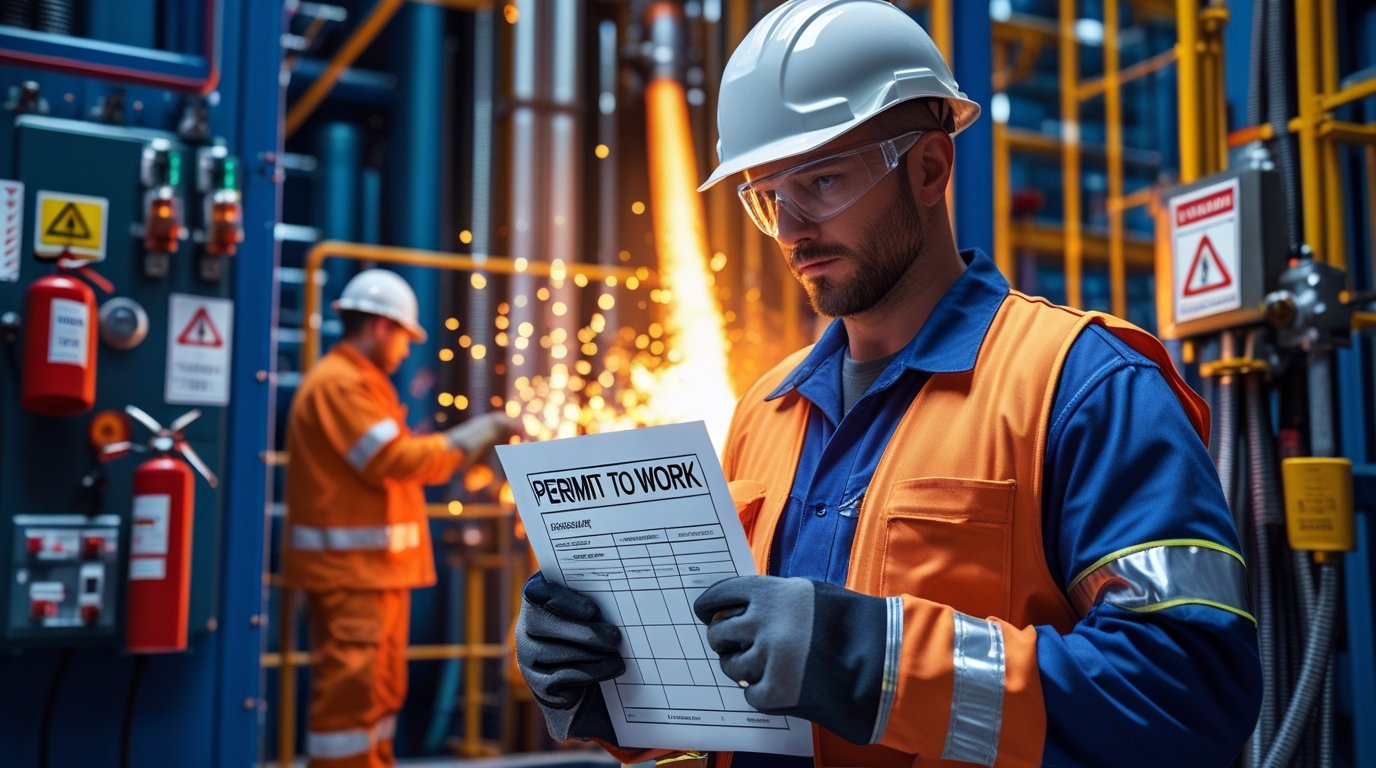
Understanding Permit to Work (PTW)
🦺 Understanding Permit to Work (PTW): A Beginner’s Guide
-
Have You Ever Heard the Term “PTW”?
Imagine working at a large manufacturing plant, a power station, a construction project, or even an oil refinery.
Just before you begin your task, your supervisor says:
“Hold on, don’t start yet—the work permit hasn’t been issued.”
That “work permit” is what we call a Permit to Work (PTW).
A PTW is not just a piece of paper, nor is it merely an administrative formality.
It is a safety control system—a kind of “safety ticket” that ensures work can be performed without causing harm to people, equipment, or the environment.
Think of it like riding a roller coaster. Before the ride starts, the operator checks that your seatbelt is fastened, your safety restraints are secure, and everything is safe.
A PTW serves a similar purpose in the workplace—it helps ensure that work is carried out safely and under control.
-
Why Do We Need a Permit to Work?
Industrial workplaces involve many high-risk activities, such as:
- Working at height
- Welding in confined areas
- Cutting gas-filled pipelines
- Opening electrical panels
- Entering confined spaces such as tanks or vessels
These activities can be fatal if performed carelessly.
This is where PTW plays a critical role.
With a Permit to Work system, high-risk tasks must be planned, reviewed, approved, and monitored before work begins.
Think of PTW as a traffic management system for work:
- There is a defined route.
- There are rules to follow.
- There are responsible persons ensuring everything stays on track.
Without PTW, people may perform work without proper controls.
And one mistake can lead to fires, explosions, serious injuries, or fatalities.
-
Who Needs a PTW?
The short answer:
Anyone performing work in industrial facilities or high-risk project environments.
More specifically, PTW is typically required for non-routine or hazardous activities, including:
- Hot Work Permit :Work involving heat, sparks, or open flames. Examples : Welding, Grinding,Cutting
- Cold Work Permit : Mechanical work that does not generate heat but still presents risks. Examples: Opening pipe flanges , Pump maintenance, Equipment repairs
- Electrical Work Permit : Work involving energized electrical systems. Examples: Panel maintenance , Cable replacement, Electrical testing
- Confined Space Entry Permit : Entry into restricted spaces such as: Tanks, Vessels , Manholes ,Silos
- Working at Height Permit : Activities conducted above specified height limits, commonly above 1.8 meters (6 feet).
- Excavation Permit : Ground excavation work that may affect underground utilities, pipelines, or cables.
- Isolation Permit / Lockout Tagout (LOTO) : Used to ensure hazardous energy sources are isolated before work begins.
Each type of work presents unique risks, which is why different permits and procedures exist.
-
Who Is Involved in the PTW Process?
Several key roles are involved:
-
- Permit Applicant / Requestor
The individual or team requesting permission to perform work. Responsibilities include: Submitting the permit request, Explaining the work scope, Ensuring workers are prepared.
-
- Permit Issuer
The authorized person responsible for issuing permits after verifying that all requirements have been met.
-
- Area Owner / Area Supervisor
The person responsible for the work location. They confirm that the area is safe for the planned activity.
-
- Performer / Worker
The personnel carrying out the work in accordance with permit requirements and procedures.
-
- Safety Officer / Fire Watch / Standby Person
Individuals assigned to monitor the activity and respond to emergencies if necessary.
PTW is therefore a team effort involving planners, supervisors, workers, and safety personnel.
-
-
The Basic Permit to Work Process
Step 1: Identify the Work
-
The work team defines the task and identifies potential hazards. Example: “We need to perform welding near a fuel storage tank.” Immediately, it is clear that this is hot work with potential fire hazards.
Step 2: Submit the Permit Request
The permit application is submitted to the PTW authority. Typical information includes: Work location , Duration , Scope of work , Personnel involved , Equipment used , Hazards and control measures
Step 3: Conduct a Site Inspection
Before approval, the work area is inspected. The inspection verifies: Area safety , Absence of hazardous gases, Equipment readiness , Emergency access routes, Availability of fire extinguishers
Step 4: Approval
If all requirements are met, the permit is approved and signed by the relevant parties.
Step 5: Pre-Job Briefing (Toolbox Talk)
Before work begins, the team discusses:
-
-
-
- Today’s task
- Hazards and controls
- Roles and responsibilities
- Supervisory arrangements
- Emergency response actions
-
-
Step 6: Execute the Work
The task is performed according to permit requirements.
A Fire Watch or Safety Watch may be assigned to monitor conditions.
Step 7: Permit Closure
Once work is completed, the area is re-inspected and the permit is formally closed.
-
A Real-Life Example
Imagine a maintenance team at a coal-fired power plant replacing a valve on a high-pressure steam line.
Without PTW:
- The pipe could still be pressurized.
- Steam temperatures could exceed 300°C.
- Workers could be exposed to severe burns or explosions.
With PTW:
- The line is isolated and locked out.
- Pressure is released safely.
- Warning tags are installed.
- All responsible parties approve the work.
- Safety personnel monitor the activity.
Only then does the work proceed safely.
-
Common Types of Work Permits
🔥 Hot Work Permit
Required for activities involving sparks, flames, or heat.
Typical controls:
- Fire extinguisher nearby
- Fire Watch assigned
- Combustible materials removed
- Gas testing conducted where required
🔧 Cold Work Permit
Required for mechanical work activities.
Potential hazards:
- Fluid release
- Residual pressure
- Mechanical injuries
⚡ Electrical Work Permit
Required for electrical work.
Potential hazards:
- Electric shock
- Arc flash
- Equipment damage
Controls often include:
- Insulated gloves
- Electrical PPE
- Lockout Tagout (LOTO)
🌫️ Confined Space Entry Permit
Required when entering restricted spaces.
- Typical controls:
- Atmospheric gas testing
- Ventilation
- Rescue arrangements
- Standby attendant
🧱 Excavation Permit
Required for digging activities.
Potential hazards:
- Trench collapse
- Underground utility strikes
- Falling objects
🧗 Working at Height Permit
Required for elevated work.
Typical controls:
- Full-body harness
- Lifeline systems
- Hard hats
- Slip-resistant footwear
-
PTW and Safety Culture
PTW is more than paperwork—it is an important part of safety culture.
When employees consistently follow the PTW process:
- They think before acting.
- Hazards are identified earlier.
- Communication improves.
- Accountability increases.
A common safety saying is:
“Accidents don’t just happen—they are caused.”
Poor permit management is often one of the contributing factors.
-
Common Mistakes
Despite having a PTW system, organizations sometimes make mistakes such as:
- Treating permits as paperwork only
- Skipping field inspections
- Failing to conduct toolbox talks
- Copying permits for unrelated work
- Not updating permits when conditions change
- Workers not understanding permit requirements
Remember:
PTW exists to protect people—not to create unnecessary bureaucracy.
-
Digital PTW Systems
Many organizations are now implementing Electronic Permit to Work (e-PTW) systems.
Benefits include:
- Online record storage
- Mobile approvals
- Automatic alerts for missing requirements
- Integration with CCTV and monitoring systems
For example, if hazardous gas is detected, the system may automatically block a hot work permit from being issued.
Digital PTW systems improve efficiency, traceability, and compliance.
-
A Simple Analogy: PTW Is Like a Driver’s License
Imagine driving on a public road.
You need a driver’s license because it demonstrates that you understand the rules and are qualified to drive safely.
A PTW serves a similar purpose.
Before performing high-risk work, you need authorization that confirms all safety requirements have been reviewed and accepted.
-
Benefits of an Effective PTW System
A well-managed PTW system can:
- Reduce workplace accidents
- Improve communication among teams
- Strengthen procedural compliance
- Support legal and audit requirements
- Protect people, equipment, and operations
-
When PTW Is Ignored
Many serious industrial incidents have involved inadequate permit controls.
Common findings from investigations include:
- No work permit issued
- No hazard assessment performed
- No gas testing conducted
- Lack of supervision
These lessons have led industries such as oil and gas, power generation, and chemicals to adopt stricter permit requirements.
-
Challenges and the Future of PTW
Common PTW challenges include:
- Excessive paperwork
- Slow approval processes
- Limited workforce understanding
- Weak supervisory commitment
However, digital technologies, continuous training, and strong leadership can significantly improve PTW effectiveness.
In the future, PTW systems may be integrated with: IoT sensors, AI monitoring , Digital twins, Real-time risk management platforms, allowing permits to adapt dynamically to changing field conditions.
-
Final Thoughts: PTW Is More Than Paperwork
Now you know what a Permit to Work really is.
It is not just a form that needs signatures.
It is one of the most fundamental risk-control tools in industrial workplaces.
When implemented correctly:
- Lives are protected.
- Assets are safeguarded.
- Operations run more smoothly.
So the next time a supervisor says:
“You can’t start yet—the permit hasn’t been issued.”
Remember that the permit may be the very thing that helps ensure everyone returns home safely at the end of the day.
✨ Quick Summary
- PTW is a formal safe work authorization system.
- It is required for high-risk activities.
- Multiple parties are involved, including applicants, issuers, supervisors, and safety personnel.
- The process includes planning, approval, monitoring, and closure.
- Success depends on communication, compliance, and a strong safety culture.