How to Determine Realistic Risk Controls in the Workplace
When discussing HSE (Health, Safety, and Environment) or workplace safety, we often hear terms such as:
- Hazard
- Risk assessment
- Mitigation
- Risk control
- Safety control
On paper, everything sounds organized, professional, and well-structured.
However, once we step into the field, a common challenge often emerges:
Risk controls are sometimes too theoretical and difficult to implement.
For example, a company may have an excellent safety procedure documented in detail, but in reality, employees rarely follow it.
Why does this happen?
Because the risk controls are not realistic. They may be overly complicated, unsuitable for actual working conditions, require unavailable resources, or create operational obstacles that encourage workers to take shortcuts.
The primary purpose of risk control is to make work safer—not to make work harder.
In the real world, effective risk controls are not the ones that look impressive in a document. They are the controls that can be consistently applied in the workplace.
This article explores how to determine realistic risk controls, why many controls fail in practice, and how to build safety systems that actually work.
What Is Risk Control?
Before going further, let’s define the concept in simple terms.
Risk control refers to actions taken to reduce the likelihood of an incident occurring or to minimize the consequences of existing hazards.
For example, if there is a slippery floor, possible risk controls may include:
- Cleaning the area
- Installing warning signs
- Requiring slip-resistant footwear
- Repairing the source of the leak
The goal is simple: prevent slips and falls.
In HSE, risk control is a critical part of the overall risk management process.
Hazards cannot always be completely eliminated, but their associated risks can often be controlled.
Why Must Risk Controls Be Realistic?
This is perhaps the most important point.
A control that looks excellent on paper may not be effective in the field.
Consider a company policy that states:
“All work activities must be performed using a full-body harness.”
In theory, this sounds like a strong safety measure.
However, what if:
- No anchor points are available
- The work area is confined
- The harnesses are damaged
- Workers have not been properly trained
In these situations, compliance becomes difficult.
What happens next?
Workers begin looking for shortcuts. The rule becomes a formality, and the risk remains.
This is why risk controls must be designed with real workplace conditions in mind.
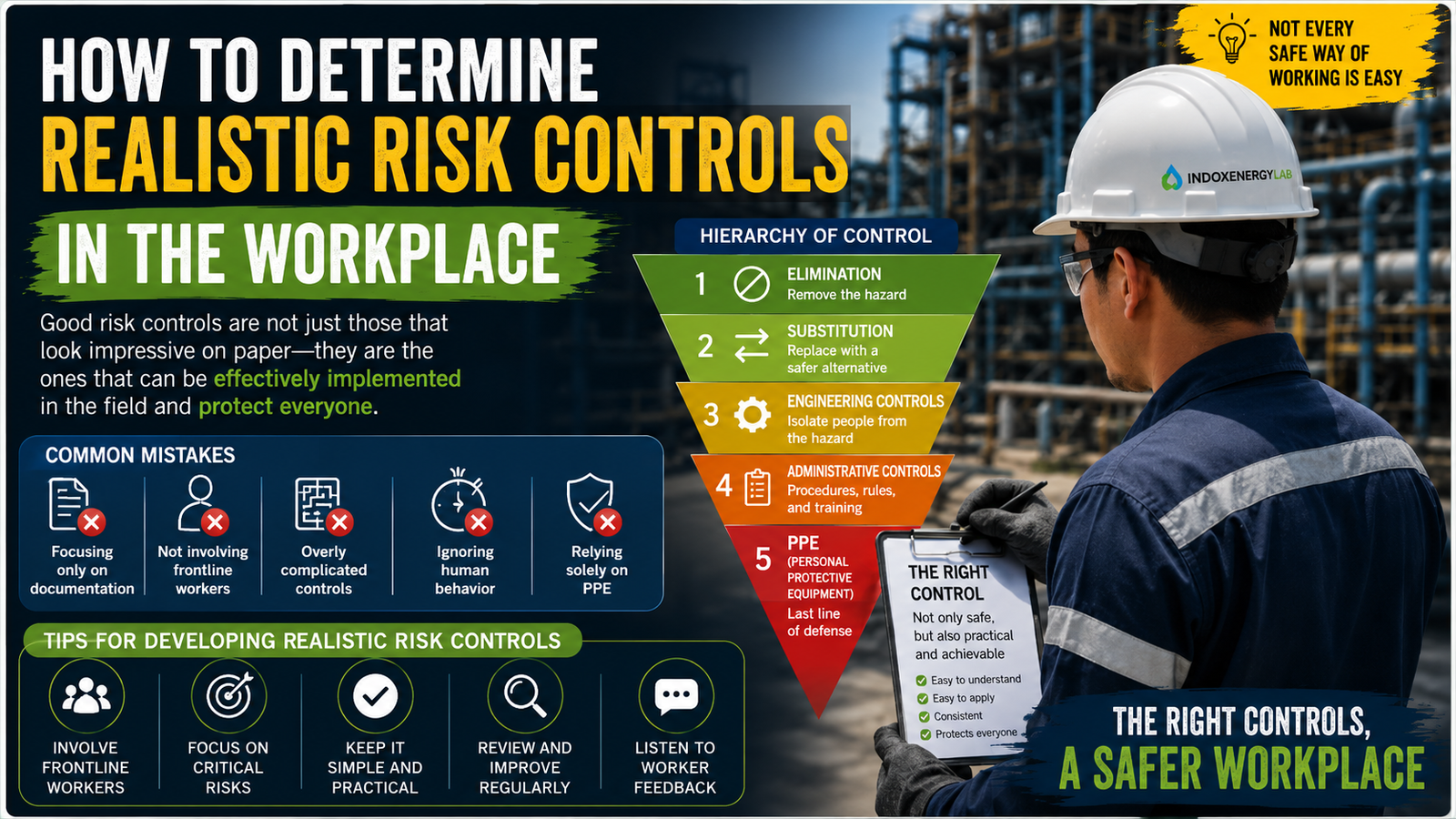
Common Mistakes When Determining Risk Controls
Many organizations already have solid HSE systems in place.
However, risk controls are not always as effective as intended.
Why?
Because several common mistakes occur repeatedly.
Focusing on Documentation Instead of Reality
Sometimes risk controls are developed primarily to satisfy audit requirements.
The documents look impressive. The wording is professional. The checklists are complete.
But when workers attempt to apply them, confusion follows.
For example, a procedure may be unnecessarily long for a simple task.
As a result, employees may ignore it because they perceive it as slowing down their work.
Safety ends up existing only on paper.
Failing to Involve Frontline Workers
This is a major issue.
Risk assessments are sometimes developed by supervisors or HSE personnel without involving the workers who actually perform the task.
Yet frontline workers often understand workplace realities better than anyone else.
They know:
- Which areas are difficult to access
- Which tools are difficult to use
- Where shortcuts are likely to occur
- Which hidden hazards exist
- What the actual working conditions are
Without worker involvement, risk controls frequently become unrealistic.
Making Controls Too Complicated
Organizations sometimes create too many rules with good intentions.
However, excessive complexity can make compliance difficult.
For example, a simple task may require multiple approvals before work can begin.
Eventually workers may think:
“It’s faster to just do the job.”
When that happens, procedures start being bypassed.
Ignoring Human Behavior
This factor is often overlooked.
People naturally prefer methods that are:
- Faster
- Easier
- More comfortable
If a risk control creates unnecessary inconvenience, workers will likely seek alternative ways to complete the task.
Examples include:
- PPE that is excessively hot or uncomfortable
- Safe routes that are too far away
- Procedures that take too long
- Excessive paperwork
Effective risk controls must take human behavior into account.
Relying Solely on PPE
Many people immediately think of PPE as the primary solution.
In reality, PPE is the last line of defense within risk management.
If the source of the hazard remains unchanged, the risk may still be significant.
For example, in a high-noise environment, the best solution is not simply providing earplugs.
A better approach is also finding ways to reduce the noise at its source.
Understanding the Hierarchy of Controls
In HSE, one of the most important concepts is the Hierarchy of Controls.
This framework helps determine which risk controls are most effective.
The hierarchy typically consists of:
- Elimination
- Substitution
- Engineering Controls
- Administrative Controls
- Personal Protective Equipment (PPE)
Let’s look at each level.
Elimination – Remove the Hazard
This is the most effective control.
If the hazard no longer exists, neither does the associated risk.
Examples include:
- Eliminating a hazardous work process
- Removing the use of a dangerous chemical
- Permanently closing access to a hazardous area
No hazard means fewer controls are needed.
Substitution – Replace with a Safer Alternative
If elimination is not possible, consider replacing the hazard with something safer.
Examples include:
- Replacing toxic chemicals with safer alternatives
- Using more advanced equipment
- Modifying work methods
This approach is often more effective than relying solely on PPE.
Engineering Controls – Separate People from the Hazard
Engineering controls involve physical or technical modifications.
Examples include:
- Machine guarding
- Ventilation systems
- Physical barriers
- Automatic sensors
- Interlock systems
Engineering controls are generally more reliable because they depend less on human behavior.
Administrative Controls – Rules and Procedures
These are among the most common controls used in workplaces.
Examples include:
- Standard Operating Procedures (SOPs)
- Permit-to-work systems
- Toolbox meetings
- Work schedules
- Safety briefings
The challenge is that administrative controls depend heavily on human compliance.
As a result, their effectiveness may decrease when the safety culture is weak.
Personal Protective Equipment (PPE)
PPE represents the final layer of protection.
Examples include:
- Hard hats
- Gloves
- Earplugs
- Safety shoes
- Face shields
PPE is important, but it should not be viewed as the primary solution because its effectiveness depends on proper use.
If PPE is not worn correctly, the protection is lost.
What Does a Realistic Risk Control Look Like?
Realistic risk controls typically share several characteristics.
Practical in the Workplace
This is the most important requirement.
If a control is difficult to follow, people are more likely to ignore it.
Controls should match:
- Actual working conditions
- Available equipment
- Workforce size
- Work schedules
- Site conditions
Easy to Understand
Complex controls create confusion.
Simple language and visual communication are often more effective than lengthy written instructions.
Do Not Unnecessarily Disrupt Operations
Safety is essential.
However, if procedures become so burdensome that work can barely proceed, shortcuts become inevitable.
A balance between safety and operational efficiency is necessary.
Consider Human Behavior
Good controls recognize how people behave in real-world situations.
For example, if workers avoid PPE because it is uncomfortable, the solution may be selecting more comfortable PPE rather than simply introducing additional rules.
Consistent and Measurable
Risk controls should be capable of being implemented consistently.
If a control only works during audits, it is probably not effective.
Why Do Many Risk Controls Fail?
Many organizations have comprehensive risk assessments and SOPs.
Yet incidents still occur.
Why?
Weak Safety Culture
Without a strong safety culture, even the best procedures struggle to succeed.
Inconsistent Supervision
Sometimes safety standards are strictly enforced only during inspections.
Afterward, compliance declines.
Workers Do Not Understand the “Why”
People are less likely to follow rules if they do not understand their purpose.
Leadership Fails to Lead by Example
When supervisors ignore safety requirements, employees often do the same.
Controls Are Created Only for Audits
This is surprisingly common.
Documents are developed to satisfy standards rather than support real workplace safety.
How to Make Risk Controls More Effective
Now let’s focus on practical solutions.
Involve Frontline Workers
The people performing the work understand the realities better than anyone else.
Risk controls should not be developed solely in meeting rooms.
Focus on Critical Risks
Not every hazard requires a complex solution.
Prioritize risks with the highest potential consequences.
Keep Controls Practical
If a control can be made simpler while remaining effective, simplify it.
Review Controls Regularly
Workplace conditions change.
Risk controls should evolve accordingly.
Listen to Employee Feedback
If workers say a control is difficult to implement, do not immediately assume resistance.
There may be a legitimate issue within the system.
The Connection Between Risk Controls and Behavior-Based Safety
Risk controls cannot be separated from human behavior.
After all, people are the ones who operate the system.
This is where Behavior-Based Safety (BBS) becomes important.
People may:
- Forget
- Rush
- Take shortcuts
- Become overconfident
Effective controls must account for these human factors.
Technology Can Help, but It Cannot Replace Safety Culture
Many organizations are now implementing:
- CCTV analytics
- Safety sensors
- AI-based monitoring
- Digital permit systems
- Smart PPE
Technology can certainly improve safety performance.
However, workplace safety still depends heavily on organizational culture and human behavior.
Regardless of how advanced a system becomes, people ultimately make the final decisions.
Good Safety Does Not Have to Be Complicated
This is an important lesson that is often forgotten.
Sometimes the most effective solutions are the simplest ones.
Examples include:
- Good housekeeping practices
- Clear communication
- Simple barricades
- Effective toolbox meetings
- Safe pedestrian walkways
Safety is not about appearing sophisticated or modern.
It is about what actually works.
Conclusion
Determining risk controls is about much more than completing risk assessment forms or writing lengthy procedures.
Effective risk controls must be realistic, practical, understandable, and aligned with actual workplace conditions.
The goal of workplace safety is not to create as many rules as possible.
The goal is to make work genuinely safer.
Overly complicated controls often encourage workers to seek shortcuts.
In contrast, simple and realistic controls are usually easier to implement consistently.
Ultimately, workplace safety is not just about documents and procedures.
It is about understanding people, understanding the work, and building a culture where everyone can work safely and return home unharmed every day.