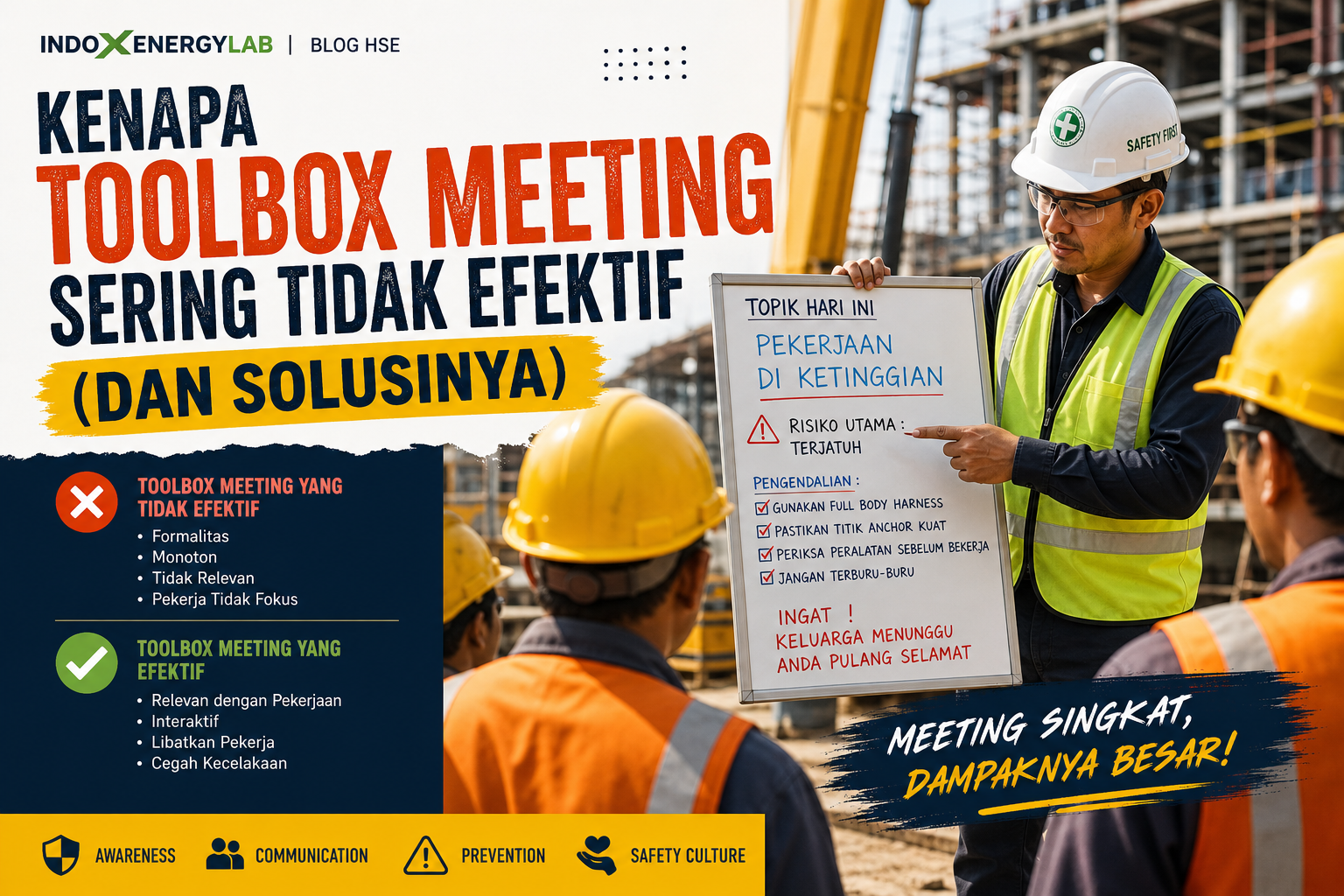
Why Toolbox Meetings Often Fail (and How to Make Them More Effective)
If you’ve ever worked on a construction project, in a factory, workshop, mine, or any other industrial environment, you’re probably familiar with toolbox meetings.
These meetings are typically held before the workday begins. Workers gather together while a supervisor or HSE officer provides a brief overview of the day’s tasks, potential hazards, required personal protective equipment (PPE), and other important safety reminders.
In theory, a toolbox meeting is one of the most important workplace safety activities. In fact, many companies require it as part of their daily routine.
But what happens in reality?
Many toolbox meetings feel boring, overly formal, rushed, or simply become another administrative requirement.
Some workers attend only to sign the attendance sheet. Others check their phones. Some nod along without really listening. Many can’t remember what was discussed just a few minutes after the meeting ends.
That raises an important question:
Are toolbox meetings truly effective?
Or have they become routine activities with little real impact on workplace safety?
In this article, we’ll explore why toolbox meetings often fail, what causes them to lose their effectiveness, how this affects safety culture, and—most importantly—how to make toolbox meetings more engaging, relevant, and valuable for everyone involved.
What Is a Toolbox Meeting?
A toolbox meeting is a short safety discussion held before work begins. It typically lasts between 5 and 15 minutes.
Topics may include:
– Hazards associated with the day’s work
– Proper use of PPE
– Changes in work conditions
– Safe work procedures
– Review of recent near misses
– Weather conditions
– Housekeeping
– Lessons learned from previous incidents
Its primary purpose is simple:
To remind workers of potential risks before they begin work.
Because toolbox meetings are conducted in small groups and often at the job site, they have tremendous potential to strengthen a company’s safety culture.
Unfortunately, they don’t always achieve that goal.
Why Are Toolbox Meetings Often Ineffective?
This is an interesting question.
Nearly every industrial company conducts toolbox meetings, but not every company succeeds in changing worker behavior.
Several common issues make toolbox meetings less effective than they should be.
Formalities Instead of Meaningful Conversations
Perhaps the biggest problem is that toolbox meetings are sometimes held simply because “they have to be.”
As a result, the focus shifts away from safety and toward administrative compliance.
As long as there is:
– An attendance sheet
– A group photo
– Signatures
– A completed checklist
the meeting is considered complete.
Meanwhile, the actual discussion receives very little attention.
Sometimes the supervisor quickly reads from a prepared script with little interaction. Workers listen half awake, and moments later everyone returns to work without truly understanding the safety message.
When toolbox meetings become meaningless routines, their impact on workplace safety becomes equally small.
The Same Topics Every Day
Let’s be honest.
How many times have you heard statements like these during a toolbox meeting?
– “Don’t forget safety.”
– “Wear your PPE.”
– “Be careful while working.”
There’s nothing wrong with these reminders.
But hearing exactly the same message every day eventually causes workers to tune it out.
The human brain naturally ignores information that is repeated over and over without variation.
Workers may be physically present, but mentally somewhere else.
A toolbox meeting should focus on the actual work planned for that day—not simply repeat the same script every morning.
Boring Presentation Style
Sometimes the issue isn’t the content.
It’s the delivery.
Some toolbox meetings feel like classroom lectures:
– One person talks continuously.
– The speaker uses a flat, monotonous voice.
– There is no interaction.
– No practical examples are provided.
Field workers generally respond better to communication that is brief, clear, and directly related to their work.
When presentations become too formal and rigid, attention disappears quickly—especially early in the morning.
The Discussion Isn’t Relevant
This also happens quite often.
Imagine the crew is preparing for a heavy lifting operation, but the toolbox meeting focuses on office ergonomics.
Or workers are assigned to a high-temperature work area while the discussion centers on general housekeeping.
Naturally, workers feel the topic has nothing to do with the tasks they’ll actually perform.
Toolbox meetings are far more effective when they address the real hazards workers will face that day.
They’re Too Long
A toolbox meeting is supposed to be brief and focused.
Yet in some workplaces, meetings drag on long enough for everyone to lose interest.
The longer the meeting, the greater the chance people stop paying attention.
Especially if the discussion wanders away from the original topic.
Short, focused conversations are almost always more effective.
Workers Aren’t Involved
Many toolbox meetings are one-way conversations.
The supervisor talks.
Everyone else stays silent.
But frontline workers often possess valuable knowledge and practical experience.
Giving them the opportunity to contribute creates much better discussions.
Topics workers might share include:
– Recent near misses
– New hazards observed on site
– Equipment issues
– PPE challenges
When workers participate, they feel respected and become more engaged in workplace safety.
Everything Feels Rushed
Sometimes toolbox meetings are squeezed into an already busy schedule.
The result sounds something like this:
“Be safe. Wear your PPE. Okay, let’s get to work.”
But the purpose of a toolbox meeting is to build safety awareness before work begins.
If it’s rushed, the message never truly reaches the workforce.
The Consequences of Ineffective Toolbox Meetings
Some people might think,
“It’s only a short meeting.”
In reality, the consequences can be significant.
Reduced Safety Awareness
Workers become less attentive to workplace hazards.
Weaker Safety Culture
When safety becomes little more than a routine, it’s difficult to build a strong safety culture.
Poor Communication
Toolbox meetings should provide opportunities to discuss field conditions, concerns, and new hazards.
When communication breaks down, important information is lost.
Greater Risk of Accidents
Poor understanding of workplace hazards naturally increases the likelihood of incidents.
What Makes a Toolbox Meeting Effective?
An effective toolbox meeting doesn’t have to be long or highly formal.
It simply needs to be:
– Relevant
– Interactive
– Easy to understand
– Closely connected to the day’s work
Workers should leave the meeting feeling that it genuinely helps them perform their jobs more safely.
How to Make Toolbox Meetings More Effective
Use Simple, Everyday Language
Not everyone is comfortable with complicated technical terminology.
Keep the message simple and direct.
Instead of saying:
“Ensure risk mitigation measures are implemented effectively.”
Try saying:
“The ground is slippery after today’s rain, so be extra careful while walking.”
Simple messages are easier to understand and remember.
Focus on Today’s Actual Hazards
This is one of the most important improvements.
If today’s work involves hot work, discuss:
– Fire hazards
– Fire extinguishers
– Gas testing
– Flammable materials
If today’s work involves lifting operations, focus on:
– Safe lifting zones
– Sling inspections
– Rigger communication
– Crane conditions
The more relevant the discussion, the more attention workers will give it.
Keep It Short
A toolbox meeting isn’t a seminar.
Five to fifteen minutes is usually enough.
Keep it brief, focused, and meaningful.
Encourage Worker Participation
Don’t let the supervisor do all the talking.
Ask simple questions such as:
– “Are there any additional hazards today?”
– “Has anyone noticed equipment problems?”
– “Were there any near misses yesterday?”
Small discussions like these encourage active participation.
Use Real Examples
Real stories capture attention much better than theory.
For example:
“Last week, someone nearly slipped because of an oil leak.”
Workers can relate to real situations much more easily than abstract safety concepts.
Vary the Presentation
Avoid repeating the same format every day.
Instead, try incorporating:
– Questions and answers
– Experience sharing
– Short quizzes
– Quick demonstrations
– PPE demonstrations
Small changes can make toolbox meetings much more engaging.
Don’t Focus Only on Rules
If every meeting consists only of:
– Don’t do this.
– Don’t do that.
– Never do this.
workers eventually lose interest.
Instead, explain why.
For example:
“Wear your earplugs because noise levels in this area can permanently damage your hearing.”
When people understand the reason behind a rule, they’re much more likely to follow it.
Supervisors Must Lead by Example
This may be the most important point of all.
If a supervisor talks about safety while failing to wear proper PPE, workers are unlikely to take the message seriously.
Safety culture always starts with leadership by example.
Toolbox Meetings and Behavior-Based Safety
Toolbox meetings are closely connected to Behavior-Based Safety (BBS).
Both focus on influencing human behavior.
A toolbox meeting shouldn’t simply remind workers about rules.
It should help build safe work habits.
When conducted effectively, toolbox meetings can:
– Increase safety awareness
– Reduce unsafe behaviors
– Strengthen communication
– Build a culture of mutual care
Ultimately, a toolbox meeting should be a conversation—not just another morning routine.
Toolbox Meetings in Today’s Workplace
The modern workforce is changing.
Younger workers often prefer communication that is:
– Fast
– Visual
– Interactive
Toolbox meetings should evolve as well.
Ideas include:
– Short safety videos
– Hazard photos
– Near miss photographs
– Creative safety campaigns
– QR codes linking to safety materials
– Interactive discussions
Safety doesn’t always have to be serious and formal.
The important thing is that the message is understood.
Common Mistakes to Avoid
Several common mistakes reduce the effectiveness of toolbox meetings:
– Reading directly from prepared material
– Using overly technical language
– Discussing irrelevant topics
– Making meetings too long
– Rushing through the discussion
– Focusing only on attendance
– Never evaluating whether the meeting was effective
If these mistakes continue, workers will eventually see toolbox meetings as nothing more than another administrative task.
Building a Strong Safety Culture Through Toolbox Meetings
Although they seem simple, toolbox meetings can have a significant influence on workplace safety culture.
After all, they happen almost every day.
Imagine workers being reminded daily about workplace hazards, discussing risks together, and sharing their experiences.
Over time, safe behavior becomes a natural habit.
Safety culture isn’t built through posters or catchy slogans.
It’s built through consistent, meaningful communication.
And toolbox meetings can become one of the most effective tools for creating that culture.
Conclusion
Toolbox meetings may seem simple, but when conducted effectively, they can have a powerful impact on workplace safety.
Unfortunately, many toolbox meetings fail because they are overly formal, repetitive, irrelevant, or treated as nothing more than an administrative routine.
The true purpose of a toolbox meeting isn’t simply taking attendance before work.
Its purpose is to build awareness and strengthen a safe working culture.
To be effective, a toolbox meeting should be:
– Short
– Relevant
– Interactive
– Easy to understand
– Closely connected to actual field conditions
Most importantly, workers should feel that the meeting genuinely helps them perform their jobs more safely—not that it’s simply another daily obligation.
Because in the end, workplace safety isn’t only about following rules.
It’s about how people think, communicate, and look out for one another every single day.