Have you ever come across the term carbon neutral in the news, electric vehicle commercials, or on social media?
At first glance, it might sound intimidating, as if there is a strict new rule: “The Earth must be 100% free from carbon, smoke, and machines!”
Of course, that assumption is incorrect. As long as humans breathe, we exhale carbon dioxide (CO₂). As long as we eat rice or bread, tractors need fuel to harvest crops. As long as our smartphones are turned on, electricity must be generated somewhere. Completely eliminating carbon down to zero percent is a biological and technological impossibility.
So, what does carbon neutral really mean? Why are nations and tech giants racing to achieve it? Let’s break it down using simple analogies and everyday language!
1. Understanding Carbon Neutral: A Balanced Scale
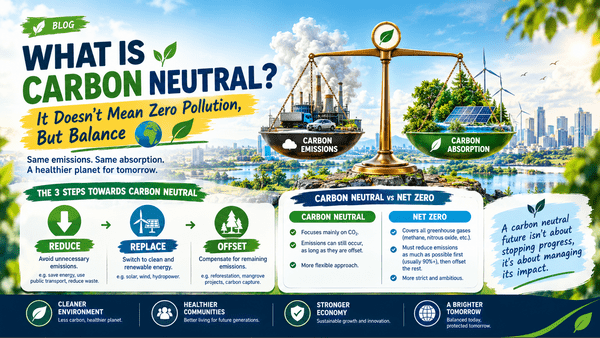
Literally speaking, carbon neutrality is not about eliminating emissions entirely, but about balancing the books.
💡 Carbon Neutrality is a state where the amount of carbon dioxide (CO₂) released into the atmosphere equals the amount absorbed or removed from the air.
In simple terms:
- ❌ It does NOT mean: Halting all human activity and producing zero emissions.
- ✅ Instead, it means: Emissions Released = Emissions Absorbed (Net Result = 0).
The Scale & Bank Account Analogies
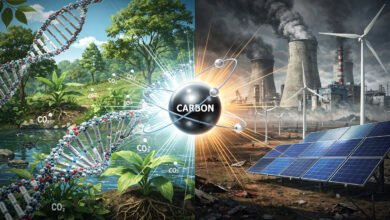
- The Hanging Balance Scale ⚖️: The left side is a bucket collecting the carbon we release from motor exhausts, factory chimneys, and air conditioning. The right side is a bucket catching the carbon absorbed by trees, mangrove forests, and advanced direct-air capture machines. Right now, the left bucket is much heavier, tilting the scale drastically. The goal of carbon neutrality is to add weight to the right and reduce the load on the left until the scale stands perfectly balanced.
- Managing Your Bank Account 💸: Think of carbon emissions as daily shopping expenses, while carbon absorption is your incoming paycheck. If you spend $100 on groceries but earn $100 from freelance work at the same time, your total savings remain intact. You break even. That is the exact equilibrium the Earth’s atmosphere aims to reach under a carbon-neutral framework.
2. Why Is the Earth’s Carbon Ledger in a Severe Deficit?
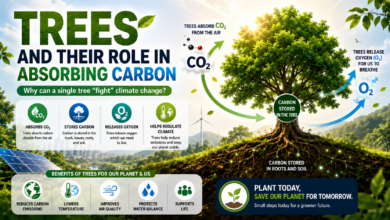
Naturally, the Earth maintains a closed and harmonious carbon cycle. Plants absorb CO₂ during photosynthesis, living organisms exhale CO₂ during respiration, and organic matter decomposes into the soil. This balance sustained the planet for millions of years.
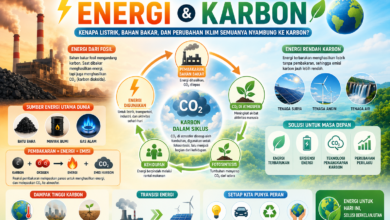
The problem began with the Industrial Revolution. Humans started excavating fossil fuels (oil, coal, and natural gas) buried for hundreds of millions of years deep beneath the Earth’s crust, burning them into the atmosphere all at once. Consequently, carbon release rapidly outpaced nature’s capacity to recycle it.
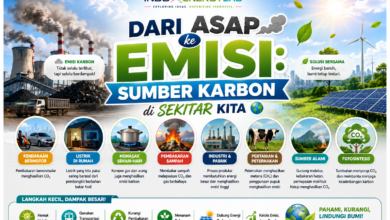
The three largest contributors to the global carbon deficit are:
- Fossil Fuel-Based Power Generation: A massive portion of global electricity still relies on coal-fired power plants. Leaving lights on needlessly or keeping electronics idling overnight directly burns coal at the other end of the wire.
- Internal Combustion Transportation: Millions of personal cars and motorbikes filling highways and city streets pump exhaust gases directly into our shared atmosphere every single minute.
- Industrial Manufacturing & Consumerism: Plastic production, steel smelting for high-rises, and the fast-fashion industry consume colossal amounts of thermal energy, leaving heavy emissions in their wake.
This accumulating blanket of CO₂ in our sky acts like the glass roof of a greenhouse: trapping solar heat and blocking it from escaping back into outer space. This phenomenon is known as the Greenhouse Effect—the prime driver of extreme heat waves, severe agricultural droughts, intense storms, and rising sea levels.
3. The 3-Step Protocol: From Smokestacks to Neutrality
Reaching carbon neutrality does not happen overnight. There is an established hierarchy of action that must be followed systematically:
[ Step 1: REDUCE ] ──> [ Step 2: REPLACE ] ──> [ Step 3: OFFSET ]
   (Cut Emissions)        (Switch Sources)      (Balance the Rest)
Step 1: Reduce
The foremost foundation is energy efficiency. Never produce emissions if the process can be streamlined. Real-world examples include optimizing supply chain logistics, designing energy-efficient buildings that utilize natural airflow, and personal habits like turning off unnecessary power switches.
Step 2: Replace
The next phase involves technological substitution. Polluting machines and energy sources are replaced with clean, renewable alternatives:
- Phasing out coal dependency in favor of Solar Photovoltaic (PV) power, wind turbines, and geothermal energy.
- Transitioning from petrol/diesel vehicles to electric mass transit, commuter buses, or bicycles.
Step 3: Offset
Even after optimizing Steps 1 and 2, certain critical sectors—such as long-haul aviation or heavy steel manufacturing—cannot easily reach absolute zero with today’s technology. These unavoidable emissions (residual emissions) must be compensated for, or “offset”.
This is accomplished by funding certified carbon-absorption initiatives elsewhere equivalent to the volume released, such as:
- Restoring coastal mangrove forests.
- Conserving protected natural forests against deforestation threats.
- Deploying technological facilities that filter CO₂ straight from ambient air (Direct Air Capture).
4. Terminology Breakdown: Carbon Neutral vs. Net Zero Emission
These two phrases are often used interchangeably in public discussions, yet their technical definitions carry fundamental differences:
| Parameter | Carbon Neutral | Net Zero Emission |
|---|---|---|
| Gas Coverage | Focuses predominantly on Carbon Dioxide (CO₂). | Covers the full spectrum of greenhouse gases, including Methane (CH₄), Nitrous Oxide (N₂O), and fluorinated industrial gases. |
| Emissions Allowance | Permits moderate emissions, provided they are balanced out with carbon offsets. | Requires slashing actual direct emissions as much as possible (typically a 90%+ direct cut) before the tiny remainder can be offset. |
| Removal Criteria | Allows conventional carbon-balancing credits bought from third-party projects. | Demands certified, permanent carbon removal and geological sequestration. |
| Ambition Level | Flexible; well-suited as a pragmatic short-to-medium-term target. | The gold standard benchmark necessary to keep global temperature rise below 1.5°C. |
5. Dispelling Three Critical Misconceptions
- “Planting Thousands of Saplings Gives Us a Free Pass to Pollute”
Trees are not instant carbon sponges. A seedling requires 10 to 20 years to mature before its carbon sequestration capacity peaks. If a factory releases 50,000 metric tons of CO₂ per year and merely plants 500 small saplings, the ledger is nowhere near balanced. Worse, if those forests burn in a wildfire, stored carbon is released right back into the sky. Planting trees is vital, but curbing emissions at the source remains priority number one. - “Carbon Neutrality Is Exclusively the Duty of Giant Corporations”
Factories produce goods because consumer demand exists. Every single-use plastic container, every expedited parcel with excessive packaging, and our daily screen time directly factor into our carbon footprint. Shifting our consumption habits serves as the most powerful brake on unsustainable industrial production. - “Pursuing Carbon Neutrality Will Cripple Economic Growth”
The green transition actively unlocks brand-new economic frontiers: battery assembly plants, rooftop solar installation services, regenerative agriculture research, and dynamic carbon credit markets. Sustainability does not mean anti-growth; it means growing intelligently without mortgaging the natural capital of future generations.
6. Realities on the Ground: Where Does Indonesia Stand?
As a tropical archipelagic nation, Indonesia plays a dual role: highly vulnerable to climate shifts, yet holding essential natural solutions for global carbon sequestration.
- Significant Hurdles: Indonesia still relies heavily on fossil energy to power its national grid via large-scale coal power plants. Decommissioning these facilities ahead of their operational lifecycle demands substantial compensation and capital-intensive replacement infrastructure.
- The Power of Blue Carbon: Indonesia boasts the largest expanse of mangrove forests and seagrass beds in Southeast Asia. Scientifically, these coastal ecosystems store carbon 3 to 5 times more densely than typical terrestrial rainforests.
- National Roadmap: The government has committed to reaching Net Zero Emissions by 2060 or sooner, supported by the rollout of a formal carbon exchange, primary forest moratoriums, and the gradual electrification of municipal public transit systems.
7. Game-Changing Future Technologies
- CCUS (Carbon Capture, Utilization, and Storage): Devices mounted directly onto the exhaust flues of heavy industries. CO₂ is intercepted before escaping, compressed into a liquid state, and injected thousands of meters underground into stable geological reservoirs or transformed into raw materials for green concrete.
- BESS (Battery Energy Storage Systems): Solar and wind energy are weather-dependent. Utility-scale battery systems store surplus clean power generated during peak daylight or windy hours, supplying the grid after dark without firing up diesel generators.
- Sustainable Aviation Fuel (SAF): Sourced from used cooking oil and agricultural biomass waste, SAF can slash the life-cycle carbon footprint of commercial aviation by up to 80% compared to conventional jet kerosene.
8. Calculating Your Personal Footprint: Practical Daily Steps
You do not need to wait for international treaties to start balancing your own carbon ledger. Meaningful systemic transformation stems from consistent micro-habits:
- Household Electricity Awareness: Turn off air conditioners when leaving the room, clean cooling filters regularly to avoid compressor strain, and switch off multi-plug power strips to stop “phantom loads” (vampire power).
- Mindful Purchasing & Diet: Industrial livestock farming is a leading source of atmospheric methane. Adopting plant-forward meals a couple of days a week (Meatless Monday) and eliminating plate food waste immediately reduces upstream supply-chain emissions.
- Multimodal Transit & Walking: Prioritize commuter trains, bus rapid transit, or local rail networks for your daily commute. Walking or cycling for distances under a mile is entirely emission-free and promotes physical health.
- Circular Habits (Reuse & Repair): Extend the usable life of electronic devices and clothing. Avoid upgrading smartphones purely for seasonal trends; the lion’s share of a smartphone’s carbon footprint happens during mineral extraction and factory assembly, not daily battery recharging.
Cultivating a New Harmony With Our Planet
Carbon neutrality is not an idealistic plea for humanity to retreat to a pre-industrial era without electricity, washing machines, or the internet. It is a manifesto of civilizational maturity: an acknowledgement that everything we extract from and release into the biosphere must be accounted for.
The Earth does not demand flawless perfection from us. What our planet urgently needs is billions of conscious people who recognize ecological boundaries, reject wasteful consumption, and actively restore the balances we disrupted. The trajectory of our climate will not be decided by empty catchphrases at high-level summits, but by the tangible choices we make every day—from the light switches in our bedrooms to how we choose to travel when stepping out the front door.