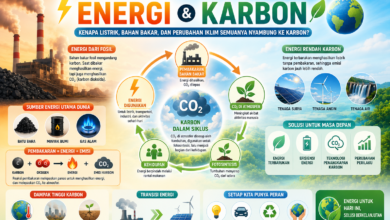
Climate change has become one of the greatest challenges facing the world today. One of its primary drivers is the increasing concentration of carbon emissions in the atmosphere.
Carbon emissions mainly come from human activities, including:
• Fossil fuel-fired power plants
• Transportation
• Industrial processes
• Inefficient energy consumption
One of the most effective ways to reduce carbon emissions is by adopting renewable energy. Among the various renewable energy technologies available today, Solar Power Plants (PLTS) have become one of the fastest-growing solutions worldwide.
Solar power systems generate electricity using sunlight without burning fossil fuels. As a result, they can significantly reduce carbon emissions.
In this article, we’ll explore carbon reduction from solar power projects, including the basics of carbon emissions, how solar energy helps reduce them, and how carbon reductions from a solar project are calculated.
What Are Carbon Emissions?
Before discussing how solar power reduces carbon emissions, it’s important to understand what carbon emissions actually are.
Carbon emissions refer to the release of carbon dioxide (CO₂) into the atmosphere as a result of human activities.
Carbon dioxide is one of the greenhouse gases that trap heat within Earth’s atmosphere. When excessive amounts accumulate, global temperatures rise, contributing to climate change.
Major sources of carbon emissions include:
• Coal-fired power plants
• Oil-fired power plants
• Natural gas-fired power plants
• Motor vehicles
• Industrial activities
Among these, the energy sector is one of the largest contributors to global carbon emissions.
Why Do We Need to Reduce Carbon Emissions?
Reducing carbon emissions is essential for protecting the environment and ensuring a sustainable future.
If carbon emissions continue to increase, several consequences may occur.
Global Warming
Greenhouse gases trap heat in the atmosphere, causing Earth’s average temperature to rise.
Climate Change
Rising global temperatures can alter weather patterns, leading to:
• Extreme rainfall
• Droughts
• More intense storms
• Rising Sea Levels
Higher temperatures melt polar ice caps and glaciers, causing sea levels to rise.
Ecosystem Disruption
Many plants and animals struggle to adapt to rapidly changing environmental conditions.
For these reasons, countries around the world are increasingly investing in clean energy solutions to reduce carbon emissions.
What Is a Solar Power Plant (PLTS)?
PLTS stands for Solar Power Plant, a system that converts sunlight into electricity using solar panels.
This process relies on photovoltaic (PV) technology.
When sunlight strikes the solar cells inside a panel, they generate direct current (DC) electricity. An inverter then converts this DC electricity into alternating current (AC), making it suitable for homes, businesses, and industrial applications.
The main advantages of solar power include:
• Abundant and renewable energy
• No air pollution during operation
• Flexible installation in a wide variety of locations
Because solar power doesn’t rely on fossil fuels, it is one of the key technologies for reducing carbon emissions.
How Does Solar Power Reduce Carbon Emissions?
Solar power reduces carbon emissions by replacing electricity that would otherwise be generated by fossil fuel power plants.
Let’s examine how this works.
Fossil Fuel Power Plants
Most of the world’s electricity still comes from fossil fuels such as:
• Coal
• Oil
• Natural gas
When these fuels are burned to generate electricity, they release carbon dioxide into the atmosphere.
The more electricity generated from fossil fuels, the greater the carbon emissions.
Solar Power Plants
Solar power systems generate electricity without combustion.
Sunlight is converted directly into electricity through photovoltaic panels. Since no fuel is burned during operation, solar power produces virtually no direct carbon emissions.
By replacing electricity generated from fossil fuels, solar power can substantially reduce carbon emissions.
Understanding Carbon Reduction
Carbon reduction refers to decreasing the amount of carbon emissions released into the atmosphere.
For a solar power project, carbon reduction is calculated by comparing two scenarios:
• Electricity generated by fossil fuel power plants.
• Electricity generated by a solar power system.
The difference in emissions between these two scenarios represents the project’s carbon reduction.
How to Calculate Carbon Reduction from a Solar Project
Several important pieces of information are needed to estimate the carbon reduction of a solar installation.
Solar Energy Production
The amount of electricity generated by a solar system over one year is typically measured in:
Kilowatt-hours (kWh)
Megawatt-hours (MWh)
Grid Emission Factor
The emission factor indicates how much carbon dioxide is produced for every unit of electricity generated by the local power grid.
For example:
If the grid emission factor is 0.8 kg CO₂ per kWh, then every kilowatt-hour generated by fossil fuel power plants produces 0.8 kilograms of CO₂.
Simple Formula
A simplified carbon reduction calculation is:
Carbon Reduction = Solar Energy Production × Grid Emission Factor
Example Calculation
Suppose a solar power plant generates:
1,000,000 kWh per year
and the grid emission factor is:
0.8 kg CO₂/kWh
The annual carbon reduction would be:
800,000 kg CO₂ per year
or approximately:
800 metric tons of CO₂ annually
Examples of Carbon Reduction from Solar Projects
Residential Rooftop Solar
A homeowner installs a rooftop solar system with a capacity of:
5 kWp
Annual electricity generation:
7,000 kWh
Using an emission factor of 0.8 kg CO₂/kWh, the annual carbon reduction is:
5,600 kg CO₂
or approximately:
5.6 metric tons of CO₂ per year
Commercial Solar Installation
A commercial building installs a solar system with a capacity of:
500 kWp
Annual electricity production:
700,000 kWh
Estimated annual carbon reduction:
560 metric tons of CO₂
Utility-Scale Solar Power Plant
A utility-scale solar farm with a capacity of:
100 MW
Annual electricity generation:
150 million kWh
Estimated annual carbon reduction:
120,000 metric tons of CO₂
This is roughly equivalent to the annual carbon emissions produced by tens of thousands of passenger vehicles.
Benefits of Carbon Reduction from Solar Projects
Reducing carbon emissions through solar power provides numerous environmental and economic benefits.
• Reduced Air Pollution
By reducing reliance on fossil fuels, solar power helps decrease air pollution that can harm human health.
• Supporting Clean Energy
Solar projects accelerate the transition toward cleaner and more sustainable energy systems.
• Mitigating Climate Change
The more solar projects are deployed, the greater their contribution to reducing global greenhouse gas emissions.
• Supporting Net Zero Targets
Many countries have adopted net-zero emissions goals, where greenhouse gas emissions released into the atmosphere are balanced by those removed or avoided.
Solar power plays a crucial role in achieving these targets.
Carbon Credits from Solar Projects
In addition to reducing emissions, solar projects can also generate carbon credits.
A carbon credit is a certificate representing a verified reduction in greenhouse gas emissions.
Typically:
1 Carbon Credit = 1 metric ton of CO₂ reduced
These credits can be traded in carbon markets.
Companies with high emissions may purchase carbon credits to offset part of their carbon footprint.
As a result, solar projects not only generate electricity but can also create additional economic value through carbon markets.
The Role of Technology in Measuring Carbon Reduction
Digital technologies now play an important role in measuring and monitoring carbon reductions.
Common technologies include:
• Solar Monitoring Systems
These systems collect real-time electricity generation data.
• Carbon Accounting Platforms
These platforms calculate greenhouse gas emissions and emission reductions from energy projects.
• Data Analytics
Data analysis helps evaluate system performance and forecast future carbon reduction potential.
• The Future of Carbon Reduction Through Solar Energy
As awareness of climate change continues to grow, the deployment of solar energy is expected to expand worldwide.
Many countries have set ambitious targets to increase solar generation capacity over the coming decades.
As more solar projects are developed, their contribution to global carbon reduction will continue to grow.
At the same time, advances in solar panels, inverters, and battery energy storage systems will make solar power increasingly efficient and affordable.
These improvements will further accelerate the global transition toward cleaner and more sustainable energy systems.
Conclusion
• Solar power is one of the most important renewable energy technologies for reducing carbon emissions.
• By generating electricity directly from sunlight without burning fossil fuels, solar systems help replace high-emission electricity sources.
• The carbon reduction achieved by a solar project can be estimated based on its electricity generation and the emission factor of the local power grid.
• The larger the solar installation and the more electricity it produces, the greater its contribution to reducing greenhouse gas emissions.
• Beyond environmental benefits, solar projects can also create economic value through carbon credits while supporting national and global net-zero emission goals.
• As technology continues to improve and awareness of climate change grows, solar power will remain one of the world’s leading solutions for reducing carbon emissions and building a cleaner, more sustainable future.