The Role of Leadership in an HSE Management System
When people hear the word leadership, they often think of high-level positions such as managers, directors, or supervisors. In reality, leadership in the workplace is not just about a job title—it’s about influence.
Across industries such as construction, manufacturing, energy, mining, oil and gas, and infrastructure projects, leadership has a significant impact on an organization’s Health, Safety, and Environment (HSE) culture.
Why?
Because employees tend to believe actions more than words.
When leaders genuinely take safety seriously, employees are more likely to do the same.
However, if leaders only talk about safety during meetings while ignoring safety rules in the field, building a strong safety culture becomes nearly impossible.
Many organizations already have:
• Comprehensive Standard Operating Procedures (SOPs)
• Modern Personal Protective Equipment (PPE)
• ISO certifications
• Advanced HSE management systems
Yet workplace accidents can still occur if leadership is weak.
Ultimately, workplace safety is not just about procedures or documentation.
It is about culture.
And culture almost always begins with leadership.
This article explores the role of leadership in an HSE management system, why it is essential for workplace safety, the common challenges leaders face, and how they can build a safety culture that truly becomes part of everyday operations.
What Is Leadership in HSE?
Leadership in HSE is much more than giving instructions.
It is the ability to influence people to work more safely, care about one another, and take responsibility for workplace safety.
An effective HSE leader is not simply someone who:
• Corrects unsafe workers
• Distributes PPE
• Completes inspection checklists
• Conducts safety meetings
Instead, an HSE leader creates a culture where safety becomes a shared value through consistent actions and daily behavior.
Leadership can come from anyone, including:
• Directors
• Managers
• Supervisors
• Foremen
• Team leaders
• Experienced workers
Anyone who influences the behavior of others is already demonstrating leadership.
Why Leadership Is Critical in HSE
Many people assume that workplace safety is simply a matter of following rules.
In reality, rules alone are never enough.
Imagine an organization with:
• Detailed SOPs
• Comprehensive risk assessments
• Safety signs throughout the workplace
• Strict permit-to-work procedures
But the supervisor frequently:
• Fails to wear PPE
• Takes shortcuts
• Ignores procedures
• Pushes employees to continue unsafe work
What is likely to happen?
Most employees will eventually behave the same way.
People naturally follow examples rather than instructions.
This is why leadership has such a powerful influence on an organization’s safety culture.
Safety Culture Always Reflects Leadership
There is a well-known saying in occupational safety:
“Culture follows leadership.”
In other words, workplace culture usually mirrors the behavior of its leaders.
When leaders consistently prioritize safety, employees are far more likely to do the same.
Conversely, if leaders focus only on production targets while overlooking safety risks, employees quickly recognize those priorities.
Workers often pay attention to seemingly small details, such as:
• Does the supervisor wear the required PPE?
• Does the manager intervene when unsafe behavior is observed?
• Does management listen when hazards are reported?
• Is safety genuinely treated as a priority?
Based on these observations, employees ask themselves one important question:
“Is safety truly important in this organization?”
Good Leadership Is Not Just for Audit Day
This is a common issue in many organizations.
Some companies become extremely disciplined about safety only during external audits.
The worksite is spotless.
Everyone wears PPE.
Documentation is perfectly organized.
Toolbox talks are conducted regularly.
Then, once the auditors leave, standards begin to slip.
When this happens, safety has not become part of the organizational culture.
Effective leadership requires consistency every day—not just when customers, auditors, or visitors are present.
The Role of Leadership in an HSE Management System
Leadership influences every aspect of workplace safety.
Let’s examine its most important responsibilities.
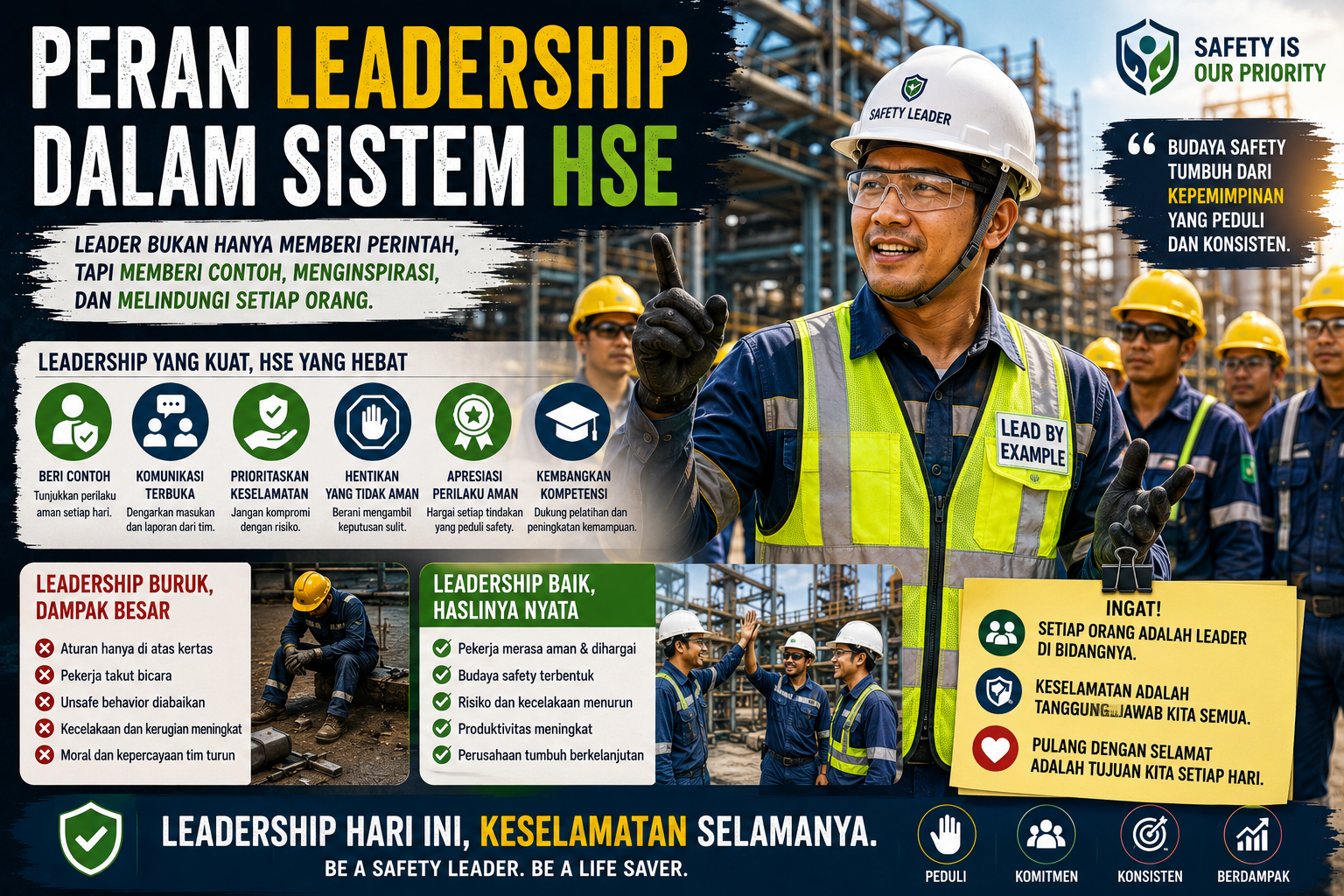
Lead by Example
Perhaps the most important responsibility of any leader is to serve as a role model.
Employees are far more likely to imitate behavior than simply follow instructions.
For example, when supervisors consistently wear:
• Safety helmets
• Safety glasses
• Safety shoes
• Full-body harnesses when required
Employees are much less likely to violate safety rules.
On the other hand, if leaders ignore safety requirements themselves, enforcing those same rules becomes extremely difficult.
Leadership begins with everyday actions.
Build a Safety-First Culture
Leaders play a central role in shaping workplace culture.
This includes:
• Reminding employees respectfully about safe practices
• Recognizing safe behavior
• Listening to hazard reports
• Avoiding unnecessary blame when mistakes occur
When employees feel respected and supported, they become more engaged in maintaining a safe workplace.
Make Safety a Genuine Priority
Every workplace experiences production pressure.
Deadlines become tight.
Workloads increase.
Schedules become demanding.
These are the moments when leadership is truly tested.
Will leaders continue to prioritize safety?
Or will they say,
“Let’s finish the job first.”
Whenever safety is sacrificed to meet production targets, the likelihood of accidents increases significantly.
Have the Courage to Stop Unsafe Work
Strong leaders are willing to stop dangerous work—even when it means:
• Delaying production
• Missing deadlines
• Facing pressure from upper management
Safety must always come first.
Projects can be rescheduled.
Equipment can be repaired.
Production losses can be recovered.
Human lives cannot.
Encourage Open Safety Communication
Healthy organizations create an environment where employees feel comfortable speaking up about hazards.
Leadership is responsible for creating that environment by:
• Listening to concerns
• Remaining approachable
• Avoiding blame
• Appreciating reports of near misses
Open communication allows hazards to be identified and controlled before they lead to serious incidents.
Support Training and Continuous Learning
Unsafe behavior is not always intentional.
Sometimes employees simply:
• Do not fully understand the risks
• Are unfamiliar with procedures
• Lack sufficient experience
For this reason, leaders should actively support ongoing safety education and training.
Leadership and Behavior-Based Safety
Leadership is closely connected to Behavior-Based Safety (BBS).
Employee behavior is heavily influenced by workplace culture and the behavior of those around them.
For example:
If everyone consistently wears PPE, new employees are likely to adopt the same habit.
However, if unsafe behavior becomes accepted as “normal,” safety violations gradually become part of the culture.
Leadership encourages safe behavior through:
• Leading by example
• Clear communication
• Active supervision
• Recognition and appreciation
• Consistent expectations
Leadership Challenges in HSE
Leading safety is not easy.
Leaders face many challenges every day.
Balancing Production Pressure
Organizations must balance:
• Productivity
• Safety
• Time
• Quality
Finding the right balance is often difficult.
Changing a Shortcut Culture
Some workplaces still have attitudes like:
“Just get it done.”
“We’ve always done it this way.”
“Don’t overcomplicate things.”
Changing these habits requires persistence, patience, and consistent leadership.
Managing a Diverse Workforce
Many worksites include:
• Permanent employees
• Contractors
• Vendors
• New hires
• Experienced personnel
Each group brings different backgrounds, experiences, and habits.
Leadership must unite everyone under the same safety culture.
Communicating Effectively
Safety messages are not always understood equally.
Challenges may include differences in:
• Language
• Education level
• Work experience
Effective leaders communicate clearly, simply, and consistently.
Poor Leadership Can Undermine an Excellent HSE System
This is one of the biggest risks in any organization.
A company may have an outstanding HSE management system.
However, poor leadership can render it ineffective.
Examples include:
• Supervisors ignoring unsafe behavior
• Managers focusing solely on production
• Leaders disregarding hazard reports
• Safety violations going unaddressed
Eventually, employees begin to think:
“Safety must not really matter here.”
At that point, the safety culture begins to deteriorate.
Positive Leadership vs. Negative Leadership
Positive Leadership
Positive leaders typically:
• Lead by example
• Listen to employees
• Care about people’s well-being
• Value safety
• Remain consistent
Negative Leadership
Negative leaders often:
• Rely on anger and criticism
• Focus only on production targets
• Ignore workplace risks
• Blame employees
• Fail to model safe behavior
Positive leadership is far more effective in building a sustainable safety culture.
Safety Leadership Is Not About Job Titles
Leadership is not reserved for managers.
An experienced employee reminding a coworker to wear PPE is demonstrating leadership.
A foreman stopping unsafe work is demonstrating leadership.
Leadership is measured by influence and action—not organizational rank.
Small Actions Create a Big Impact
Sometimes the strongest examples of leadership are the simplest ones.
Examples include:
• Greeting employees on site
• Asking about working conditions
• Listening to safety concerns
• Helping solve problems
• Recognizing safe behavior
These small actions build trust and reinforce a culture of care.
Technology Cannot Replace Leadership
Today, many organizations use technologies such as:
• AI-powered CCTV analytics
• Smart PPE
• Digital safety management systems
• Automated monitoring tools
These technologies provide valuable support.
However, technology alone cannot create a strong safety culture.
People still make the final decisions.
Leadership remains the most important factor.
Characteristics of Effective HSE Leaders
Successful HSE leaders typically demonstrate several key qualities:
• Consistency
• Genuine concern for people
• Strong field presence
• Courage to make safety-first decisions
• Excellent communication skills
• Commitment to continuous learning
• Focus beyond documentation and compliance
Most importantly, they truly believe that safety is the organization’s highest priority.
Safety Leadership Beyond the Workplace
Safety leadership is not limited to industrial environments.
We see it every day.
Parents teach their children to wear bicycle helmets.
Teachers remind students to stay safe at school.
Older siblings help younger ones cross the street safely.
These are all examples of safety leadership.
A strong safety culture begins with everyday habits.
Building a Safety Culture Takes Time
A positive safety culture cannot be created overnight.
It requires:
• Consistency
• Leading by example
• Open communication
• Patience
• Genuine care for people
Leadership is the driving force behind this process.
Conclusion
Within an HSE management system, leadership is not defined by authority or position.
It is defined by the ability to influence others to work safely and to genuinely care about the well-being of everyone around them.
A strong HSE system is not built solely through procedures, audits, or certifications.
It is built through consistent leadership, meaningful communication, and a workplace culture that values people above all else.
Employees ultimately follow what their leaders do—not simply what they say.
When leadership is strong, safety culture flourishes.
When leadership is weak, even the best procedures struggle to succeed.
Workplace safety is not the responsibility of the HSE department alone.
It is a shared responsibility across every level of the organization.
And it all begins with one simple thing:
Leaders who genuinely care.