Understanding Tier 1, Tier 2, Tier 3, and Tier 4 Data Centers
Introduction
When you hear the term data center, you might imagine a large room filled with blinking servers, powerful cooling systems, and cutting-edge technology. But in reality, not all data centers are created equal.
Some data centers experience occasional outages, while others are designed to remain operational almost all the time. To measure and classify the reliability of a data center, the industry uses an international standard known as:
Data Center Tier Classification (Tier I through Tier IV)
In this article, we’ll discuss:
• What a Data Center Tier is
• Why Tier classifications matter
• The differences between Tier I, Tier II, Tier III, and Tier IV
• Real-world examples
• Simple analogies to make the concepts easier to understand
Don’t worry—we’ll keep it practical and easy to follow, not like a university textbook. 😄
Why Do Data Centers Need Tiers?
Before discussing each Tier level, let’s answer an important question:
Why do data centers need to be classified?
Imagine this:
• Your home loses power for two hours—you can probably tolerate it.
• A hospital loses power for two minutes—it could become life-threatening.
• A bank’s data center loses power for just ten seconds—millions of dollars in transactions could fail.
Clearly, not every facility requires the same level of reliability.
A Data Center Tier indicates:
• The level of infrastructure reliability
• The robustness of its electrical system
• The resilience of its cooling system
• Its ability to continue operating during failures or maintenance
The Tier Standard was developed by the Uptime Institute, the globally recognized authority on data center infrastructure standards.
What Is a Data Center Tier?
A Data Center Tier is a classification system that describes:
• The infrastructure design
• Reliability level
• Availability
• Fault tolerance
• Ability to continue operating during failures
There are four levels:
1. Tier I
2. Tier II
3. Tier III
4. Tier IV
As the Tier level increases:
• Construction costs increase
• Infrastructure becomes more complex
• Downtime becomes significantly lower
Important Concepts Before Learning the Tiers
Before diving into each Tier, let’s understand a few basic terms.
Downtime
Downtime is the period when an IT system cannot be used.
Examples include:
• A website cannot be accessed.
• A server shuts down.
• An application completely stops functioning.
Redundancy
Redundancy means having backup components available.
Examples include:
• Two UPS systems—if one fails, the other continues operating.
• Dual electrical power paths.
• Two cooling systems.
Redundancy helps maintain service continuity.
Single Point of Failure (SPOF)
A Single Point of Failure (SPOF) is any single component whose failure causes the entire system to stop.
A well-designed data center minimizes or eliminates SPOFs.
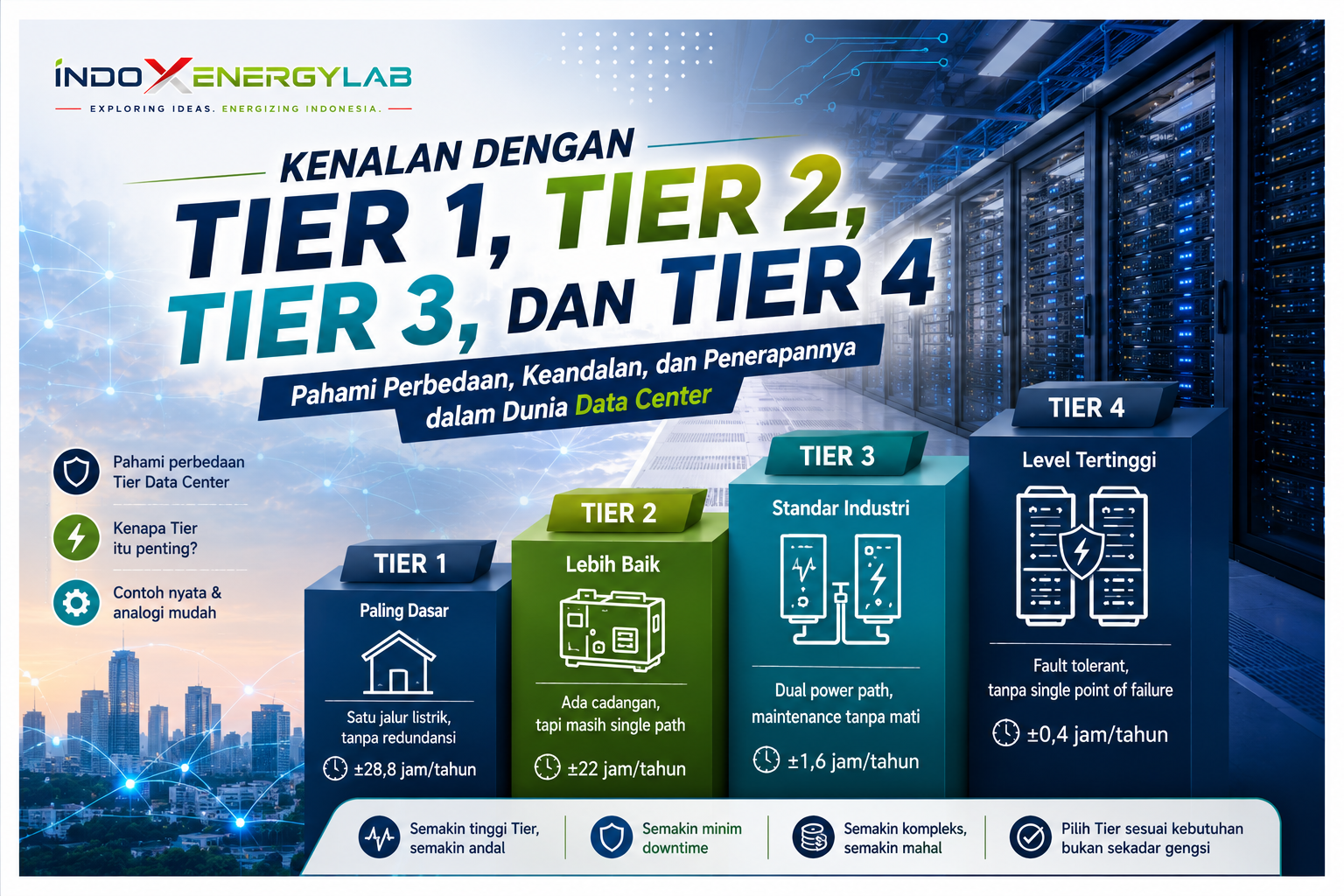
Tier I Data Center – The Basic Level
Overview
Tier I is the simplest level of data center infrastructure.
Think of it as:
A typical house with only one electrical connection.
If the power goes out, everything goes dark.
Characteristics
A Tier I data center typically has:
• One power distribution path
• One cooling system
• No redundant components
• Maintenance that requires a complete shutdown
• Heavy dependence on the utility power grid
Downtime
Typical annual downtime:
Approximately 28.8 hours per year
That’s more than an entire day of service interruption each year.
Typical Applications
Tier I is commonly used for:
• School laboratory servers
• Small office servers
• Small internal company data centers
• Early-stage startups with limited budgets
Advantages
• Low construction cost
• Simple design
• Easy operation
Disadvantages
• Highly vulnerable to outages
• Unsuitable for mission-critical businesses
• Maintenance always requires downtime
Tier II Data Center – A Step Up
Overview
Tier II offers greater reliability than Tier I.
Imagine:
A house equipped with a backup generator—but still only one main electrical path.
Characteristics
Tier II generally includes:
• Backup UPS systems
• Backup generators
• A single power distribution path
• Partial redundancy
• Cooling systems typically designed with N+1 redundancy
Downtime
Typical annual downtime:
Approximately 22 hours per year
An improvement over Tier I, but outages still occur.
Typical Applications
Tier II is commonly used for:
• Medium-sized companies
• Universities
• Regional data centers
• Internal enterprise systems
Advantages
• Better reliability than Tier I
• Basic backup capability
• Reasonable investment cost
Disadvantages
• Still contains Single Points of Failure
• Maintenance can still interrupt operations
• Not suitable for highly critical 24/7 services
Tier III Data Center – The Modern Industry Standard
Overview
Tier III is often considered the sweet spot for modern commercial data centers.
Imagine:
A house with dual electrical connections, backup generators, separate electrical panels, and the ability to perform renovations without losing power.
Characteristics
Tier III facilities feature:
• Dual power distribution paths
• One active path and one standby path
• Concurrent maintainability
• Maintenance without downtime
• N+1 redundancy across most critical systems
Downtime
Typical annual downtime:
Approximately 1.6 hours per year
This means the facility remains online almost continuously.
Typical Applications
Tier III is widely used by:
• Commercial data centers
• Cloud service providers
• Banks
• E-commerce companies
• Telecommunications operators
Advantages
• High reliability
• Maintenance without service interruption
• Ideal for 24/7 operations
• Excellent balance between cost and reliability
Disadvantages
• High construction cost
• More complex infrastructure
• Requires experienced operations personnel
Tier IV Data Center – The Highest Level
Overview
Tier IV represents the highest level of data center infrastructure.
Imagine:
Two fully equipped luxury homes built side by side.
If one becomes unusable, the other continues operating without interruption.
Characteristics
Tier IV includes:
• Dual active power paths
• 2N or 2N+1 redundancy
• No Single Points of Failure
• Fault-tolerant infrastructure
• Continuous operation even after major component failures
Downtime
Typical annual downtime:
Approximately 0.4 hours per year (about 24 minutes)
In practice, outages are extremely rare.
Typical Applications
Tier IV is commonly used by:
• National and international banks
• Stock exchanges
• Military data centers
• Hyperscale cloud core infrastructure
• National security and government systems
Advantages
• Maximum reliability
• Near-zero tolerance for downtime
• Highest levels of resilience and stability
Disadvantages
• Extremely expensive
• High energy consumption
• Very complex design and operation
• Unnecessary for many business applications
Tier I–IV Comparison
| Feature | Tier I | Tier II | Tier III | Tier IV |
| Power Paths | 1 | 1 | 2 | 2 Active |
| Redundancy | None | Partial | N+1 | 2N |
| Maintenance Without Downtime | ❌ | ❌ | ✅ | ✅ |
| Annual Downtime | 28.8 hours | 22 hours | 1.6 hours | 0.4 hours |
| Infrastructure Complexity | Low | Low | High | Very High |
| Cost | Low | Moderate | High | Very High |
Is a Higher Tier Always Better?
Not necessarily.
It depends on your operational requirements.
Examples:
• Personal blog → Tier I is sufficient.
• University systems → Tier II or Tier III.
• Banking services → At least Tier III.
• Stock exchanges → Tier IV.
Choosing a Tier is about business requirements, not prestige.
Data Center Tiers in Indonesia
In Indonesia:
• Many commercial data centers are already built to Tier III standards.
• Tier IV facilities remain relatively limited due to their high investment cost.
• Hyperscale data centers are rapidly emerging.
• Data centers have become the backbone of:
o Cloud computing
o Artificial Intelligence (AI)
o FinTech
o E-commerce
As Indonesia’s digital economy continues to grow, Tier standards are becoming increasingly important.
Conclusion: Why Should You Understand Data Center Tiers?
Even if you are:
• Not an IT professional,
• Still in school,
• Or just beginning your studies,
understanding Data Center Tiers is valuable because almost every digital service you use depends on them.
From:
• Online games
• YouTube
• Digital wallets
• AI applications
all rely on reliable data center infrastructure.
Data Center Tiers are the invisible foundation of our digital world.
Hopefully, the next time you hear someone say,
“This facility is a Tier III data center,”
you’ll immediately understand what that means:
“That’s a data center designed for concurrent maintenance, allowing maintenance activities without causing downtime.”