Why Can Solar Panels Generate Electricity?
What Are Solar Cells, Solar Panels, and Why Can Solar Panels Generate Electricity?
Solar energy is one of the most abundant energy sources on Earth. Every day, the Sun radiates enormous amounts of light and heat across our planet. Without the Sun, life on Earth as we know it would not exist.
But did you know?
Besides providing light and warmth, the Sun can also generate electricity.
This is made possible through a technology known as solar cells and solar panels.
This technology has become increasingly popular because it is a form of renewable energy that is environmentally friendly. Today, many homes, commercial buildings, and even large-scale power plants use solar panels to produce electricity.
But what exactly are:
• Solar cells?
• Solar panels?
• Why can solar panels generate electricity?
Let’s explore these questions in a simple and easy-to-understand way.
Understanding Solar Energy
Before learning about solar cells and solar panels, it’s important to understand solar energy itself.
The Sun is a star located approximately 150 million kilometers (93 million miles) from Earth. Despite this enormous distance, its energy reaches our planet in the form of:
• Light
• Heat
• Electromagnetic radiation
The amount of energy the Sun provides is astonishing. In fact, the solar energy that reaches Earth in just one hour exceeds the total energy consumed by humanity in an entire year.
Because of this incredible potential, scientists have developed technologies to capture and convert sunlight into useful energy.
One of the most successful technologies is the solar cell.
What Is a Solar Cell?
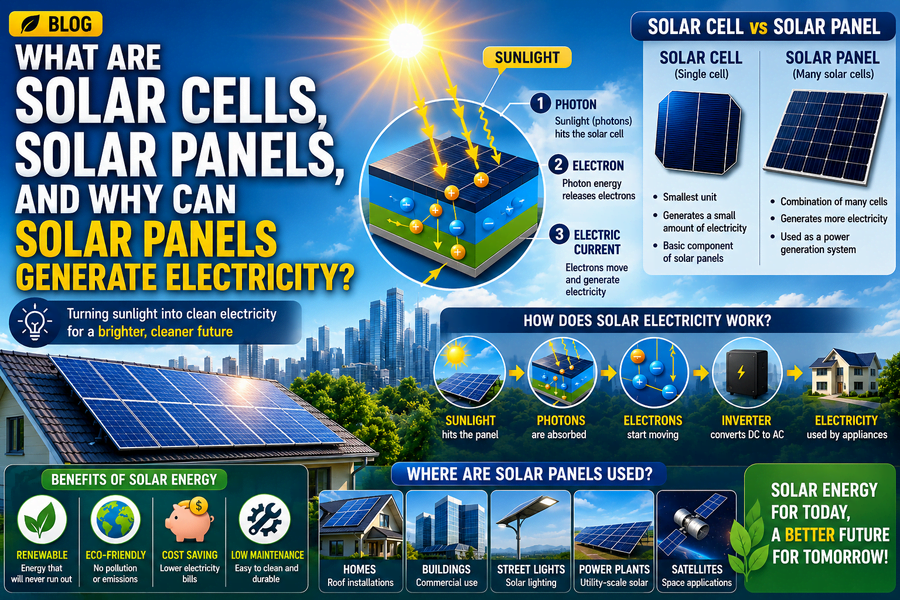
A solar cell is an electronic device that converts sunlight directly into electricity.
In simple terms, a solar cell is the smallest building block of a solar power system. Each cell is typically about the size of the palm of your hand—or even smaller.
Although small, a solar cell has an impressive capability: it transforms sunlight into electrical energy.
Solar cells are primarily made from a material called a semiconductor.
The most commonly used semiconductor is silicon.
What Is a Semiconductor?
A semiconductor is a unique material.
It is neither a perfect electrical conductor like metal nor a complete insulator like plastic.
Because of these special electrical properties, semiconductors can control the movement of electric current.
Semiconductors are used in many electronic devices, including:
• Computers
• Smartphones
• Televisions
• Electronic chips
Inside a solar cell, the semiconductor is responsible for converting sunlight into electricity.
Components of a Solar Cell
A typical solar cell consists of several important layers.
1. Silicon Layer
This is the main layer that absorbs sunlight.
It usually consists of two types of silicon:
• P-type silicon
• N-type silicon
These two layers carry different electrical charges, creating the electric field needed to generate electricity.
2. Conductive Layer
This layer collects and carries the electricity produced by the solar cell.
It usually appears as thin metallic lines on the surface of the cell.
3. Protective Layer
This outer layer protects the solar cell from:
• Rain
• Dust
• Physical damage
What Is a Solar Panel?
If a solar cell is a single unit, a solar panel is a collection of many solar cells connected together.
Solar panels are also called solar modules.
A typical panel contains dozens to hundreds of interconnected solar cells.
By combining many cells, a solar panel can generate much more electricity than a single cell alone.
Solar panels are commonly installed on:
• Residential rooftops
• Commercial buildings
• Solar power plants
• Solar-powered streetlights
The more panels installed, the greater the amount of electricity that can be produced.
Solar Cell vs. Solar Panel
Understanding the difference is easy.
Solar Cell Solar Panel
Smallest unit Collection of many solar cells
Small in size Much larger
Produces a small amount of electricity Produces significantly more electricity
Individual component Complete electricity-generating module
Simply put:
A solar cell is one component, while a solar panel is a group of many solar cells working together.
Why Can Solar Panels Generate Electricity?
This is one of the most fascinating questions.
How can sunlight be transformed into electricity?
The answer lies in a phenomenon called the photovoltaic effect.
What Is the Photovoltaic Effect?
The photovoltaic effect is the process of converting sunlight directly into electricity.
The word photovoltaic comes from two terms:
• Photo = light
• Volt = electricity
This phenomenon was first discovered in 1839 by French physicist Alexandre Edmond Becquerel.
His discovery became the scientific foundation for today’s solar panel technology.
How Is Electricity Generated?
Let’s break the process down into simple steps.
Step 1: Sunlight Reaches the Solar Panel
When sunlight shines on a solar panel, it arrives in tiny packets of energy called photons.
Step 2: Photons Strike the Solar Cell
The photons enter the solar cell and hit the silicon layer.
The energy carried by these photons knocks electrons loose from the silicon atoms.
Step 3: Electrons Begin to Move
Once freed, the electrons start moving.
This movement of electrons creates an electric current.
Step 4: Electricity Flows
The moving electrons are collected by conductive pathways and directed into an electrical circuit.
This electricity can then power everyday devices such as:
• Lights
• Televisions
• Refrigerators
• Computers
Why Don’t Solar Panels Always Produce Maximum Electricity?
Although solar panels are highly effective, they do not produce the same amount of electricity all the time.
Several factors influence their performance.
Factors That Affect Solar Panel Performance
1. Sunlight Intensity
The stronger the sunlight, the more electricity the panel can generate.
On cloudy days, electricity production is typically lower.
2. Time of Day
Solar panels generally produce the most electricity between:
• 10:00 a.m.
• 2:00 p.m.
During these hours, the Sun is positioned highest in the sky.
3. Installation Angle
Solar panels should be installed at the proper angle to capture the maximum amount of sunlight.
4. Temperature
Interestingly, solar panels perform better when they are warm but not excessively hot.
Very high temperatures can slightly reduce their efficiency.
5. Shading
If part of a panel is shaded by trees, buildings, or other objects, its electrical output can decrease significantly.
What Happens After Electricity Is Generated?
Solar panels produce direct current (DC) electricity.
However, most household appliances use alternating current (AC) electricity.
For this reason, an additional device called an inverter is required.
The inverter converts:
DC electricity → AC electricity
Once converted, the electricity is ready to power homes, businesses, and other electrical systems.
Where Are Solar Panels Used?
Today, solar panels are used in many different applications.
Homes
Many homeowners install rooftop solar panels to reduce their electricity bills.
Commercial Buildings
Office buildings and commercial facilities use solar energy to lower operating costs and improve sustainability.
Street Lighting
Many cities now use solar-powered streetlights equipped with small solar panels.
Satellites
Solar panels are also essential for satellites and spacecraft.
Since there is no conventional power grid in space, sunlight becomes their primary source of energy.
Advantages of Solar Energy
Solar panels offer many benefits compared with conventional energy sources.
1. Renewable Energy
Solar energy will remain available as long as the Sun continues to shine.
2. Environmentally Friendly
During operation, solar panels produce:
• No smoke
• No air pollution
• No direct carbon emissions
3. Lower Electricity Costs
When properly installed and maintained, solar panels can significantly reduce electricity bills.
4. Low Maintenance
Solar panels generally require only occasional cleaning to remove dust and dirt.
Challenges of Using Solar Panels
Despite their many advantages, solar panels also have some limitations.
High Initial Investment
Installing a solar system requires a relatively high upfront cost.
However, these costs are often recovered through electricity savings over several years.
Dependence on Sunlight
Solar panels cannot generate electricity at night.
Therefore, many systems rely on:
• Battery energy storage
• Grid electricity as backup
The Future of Solar Panel Technology
Solar technology continues to improve rapidly.
Researchers are developing solar panels that are:
• More efficient
• More affordable
• More durable
Emerging technologies are even making solar panels:
• Transparent
• Flexible
• Ultra-thin
In the future, we may see solar panels integrated into:
• Building windows
• Electric vehicles
• Highways
• Even smart clothing
Conclusion
Solar cells and solar panels are among the most important technologies in today’s clean energy transition.
A solar cell is a small device that converts sunlight directly into electricity.
A solar panel is a collection of many solar cells connected together to produce a much larger amount of electrical power.
Solar panels generate electricity through the photovoltaic effect, where sunlight energizes electrons inside semiconductor materials, causing them to flow and create an electric current.
With the vast amount of solar energy available on Earth, solar technology is expected to become one of the world’s leading energy sources in the years ahead.
And perhaps one day, a significant portion of the world’s electricity will come directly from the Sun. ☀️⚡